pamphlet
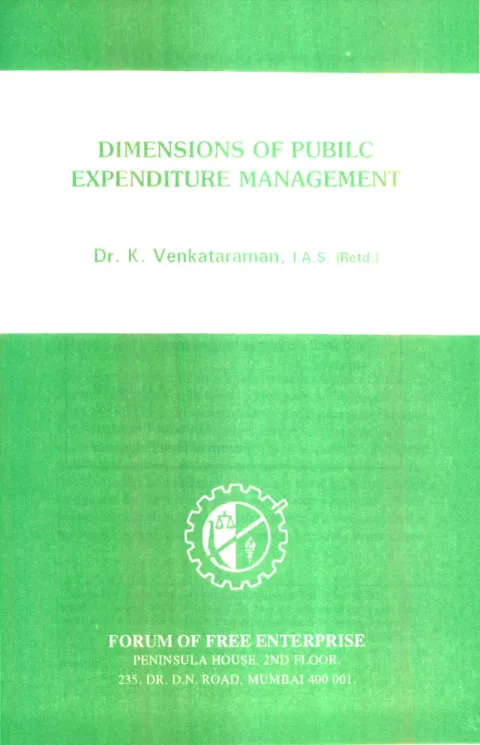
Dimensions of Public Expenditure Management
Published by M.R. Pai for the Forum of Free Enterprise, "Peninsula House", 235, Dr. D.N. Road, Mumbai 400 001. · Mumbai · 2002
16 pages
Summary
Dr. K. Venkataraman, a former civil servant and Chairman of the Public Expenditure Round Table (PERT) in Chennai, uses this Forum of Free Enterprise booklet to argue that India’s public expenditure has grown into a quietly destabilising force that academic and political debate has neglected. Drawing on numbers through the late 1990s, he documents that Central Government expenditure was doubling roughly every five years through the 1980s and 1990s, that the combined fiscal deficit of the Centre and the States hovered near 10% of GDP, and that as much as 86% of the Centre’s internal borrowings were going to service existing debt — a trajectory he labels a possible “debt trap” in which an entire revenue budget could one day be consumed by interest payments alone.
Venkataraman frames this not just as a budgetary problem but as a paradigm shift that has happened without articulation: the revenue/capital distinction has eroded, subsidies have become a permanent fixture, public capital formation has stalled, and competitive populism between States — symbolised by free agricultural electricity — keeps Chief Ministers trapped in a “Who will bell the cat?” stand-off. He calls for the Centre and States to negotiate a joint Expenditure Policy Resolution for the next decade, for the Finance Commission and State Finance Commissions to systematically match functions to finances through vertical transfers, and for a White Paper exercise modelled on the UK Government’s early-1980s reform.
The second half of the booklet turns to procedure and accountability. Venkataraman flags weak parliamentary scrutiny (guillotine voting on demands for grants, neglected Public Accounts Committee reports), the conflation of “spending the allocation” with “effectiveness,” and the absence of impact analysis or beneficiary feedback. He floats borrowing Quality Circles and ISO 9000 thinking for public services, asks whether sunset rules and measurable departmental outputs can be imported into Indian budgeting, and proposes a four-pronged “awareness generation” programme — transparent budget documents, informed public debate, civic education of the young, and direct beneficiary feedback to departments — with the media as connective tissue.
His closing argument is that the problematique of public expenditure is a “creeping malaise” that coalition politics has made political will harder to summon, and that the subject is “too important to be left to governments alone” — a citizens-and-taxpayers project rather than a Finance Ministry one.
Key points
-
Central Government expenditure grew by 136% in the first half of the 1980s, 98% in the second half, and 74% in the first half of the 1990s; the combined Centre+State fiscal deficit is around 10% of GDP.
-
Interest payments now consume over 25% of the Centre’s revenue budget and the State Governments’ interest burden has risen 50% in three years; the Comptroller and Auditor General has flagged that 86% of internal borrowings go to debt service — a possible debt trap.
-
The revenue/capital distinction has been hollowed out, public capital formation has slowed, and capital expenditure is taking a back seat to a “predatory revenue deficit.”
-
Competitive subsidisation between States (e.g., free electricity for agricultural consumers) is recognised as unviable even by the States themselves, but no single Chief Minister can step back unilaterally; a joint Centre–State review is proposed.
-
Venkataraman calls for matching functions and finances through more rigorous vertical transfers, a White Paper on public expenditure (modelled on the UK reform of the early 1980s), measurable departmental outputs, sunset rules, and a multi-year medium-term expenditure forecast.
-
Democratic accountability has failed to stem the tide: legislatures pass demands for grants by guillotine, Parliamentary Standing Committees lack sustained impact, and Public Accounts Committee reports rarely move the executive.
-
He proposes a four-part “awareness generation” programme — demystified budget documents, informed public debates, civic education of younger citizens, and direct beneficiary feedback to government departments — with media as an indispensable amplifier.
-
The booklet positions the Public Expenditure Round Table (PERT), Chennai, as one institutional vehicle for this citizen-side scrutiny and reaffirms the Forum of Free Enterprise’s stance that fiscal restraint is a condition for democratic free enterprise.
Metadata and summary are AI-extracted from the source PDF and reviewed for editorial accuracy. The original work is available via the Read PDF tab above (where present); paragraph-level citation inside the PDF is deferred to a future engagement.