pamphlet · collected works
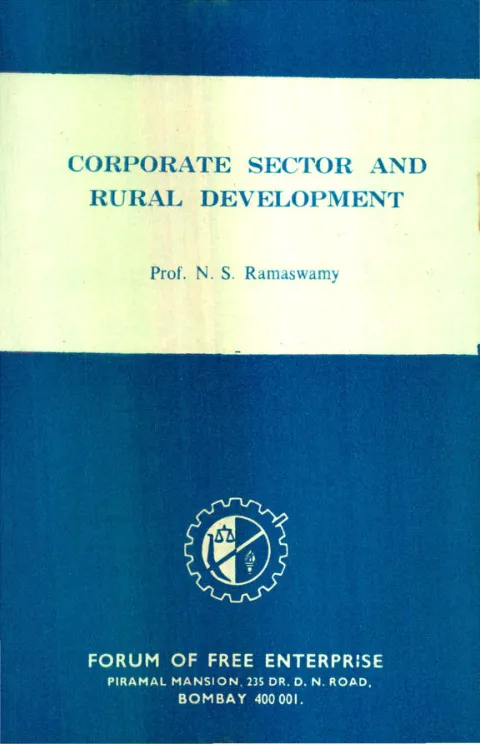
Corporate Sector and Rural Development
FORUM OF FREE ENTERPRISE, PIRAMAL MANSION, 235 DR. D. N. ROAD, BOMBAY 400 001. · Bombay · 1977
22 pages
Summary
This 1977 Forum of Free Enterprise booklet collects two papers by Prof. N. S. Ramaswamy — formerly Director of N.I.T.I.E., Bombay, and at the time of publication Director of the Indian Institute of Management, Bangalore. The publisher’s introduction frames the booklet as a response to the Union Budget 1977-78’s incentive for corporate engagement with rural development, and as a contribution to Forum publications’ long-running argument that India’s agricultural and rural economy has been neglected by policy-makers and the modern industrial sector alike.
In the first paper, ‘Social Marketing’, Ramaswamy argues that agencies of the State have proved ‘largely ineffective’ at transmitting science, technology and modern organisation to villages, and that business and industrial organisations must therefore play a complementary role. He coins ‘social marketing’ to describe the delivery of scientific and technological knowledge — alongside the products and services that industry already sells in rural areas — and frames this as ‘enlightened self-interest’ rather than philanthropy. Concrete agendas are sketched for steel producers, fertiliser firms, tyre and pump-set manufacturers, banks, insurers and food-processing companies. He cites a company that successfully augmented rural incomes in the Etawah district of Uttar Pradesh through R&D-led supply chains, and calls on rural banks to recover the relational, trust-based role of the older village money-lender.
In the second paper, ‘Modernizing the Bullock-Cart’, Ramaswamy makes the case for the bullock-cart as appropriate technology for a ‘capital-scarce, labour-surplus’ economy. Drawing on Planning Commission, National Planning Committee and IIM-Bangalore field data, he documents that India has over 140 lakh carts carrying perhaps 40 billion tonne-kilometres of freight a year and employing some 200 lakh people, and argues that motorised vehicles cannot competitively replace bullock-carts on short rural routes. He calls for sustained R&D investment in cart design and in dual-purpose draught animals, arguing that doubling carrying capacity could double the incomes of rural people dependent on the system.
Both papers share the booklet’s central polemic: rural India deserves the same modernising attention the organised economy enjoys, and the corporate sector — through self-interested service rather than charity, and by valuing rather than displacing existing non-organised technologies — should be a principal vehicle of that modernisation.
Key points
-
Forum of Free Enterprise pamphlet (October 1977) reprinting extracts from two papers by N. S. Ramaswamy, framed by an editorial introduction linking the booklet to incentives in the Union Budget 1977-78 for corporate involvement in rural development.
-
Paper I argues State agencies have been ‘largely ineffective’ at modernising villages and that industry must complement them, coining ‘social marketing’ to describe the delivery of scientific and technological know-how alongside marketed goods.
-
Corporate engagement in rural areas is defended as ‘enlightened self-interest’ rather than philanthropy — industry ultimately gains through growing, marketable rural output.
-
Sector-specific agendas are sketched for steel, fertiliser, tyre, pump-set, pharmaceutical, food-processing and petroleum firms, and for banks and insurers willing to adapt to rural realities.
-
The author calls on rural banking to recover the relational, trust-based role once played by the village money-lender and notes that villagers are ‘more willing to save than to borrow’.
-
Paper II positions the bullock-cart as ‘appropriate technology’ for a capital-scarce, labour-surplus economy, with over 140 lakh carts in use, an aggregate investment of around Rs. 3,000 crore and employment for roughly 200 lakh people.
-
Drawing on Planning Commission and IIM-Bangalore field data, Ramaswamy estimates that the bullock-cart system carries between 10 and 41 billion tonne-kilometres of freight a year — comparable in scale to the Railways and road transport.
-
He argues that the bullock-cart has been neglected because animals were assumed to be replaceable by tractors and trucks, but that motorised vehicles are uneconomic over short distances and require petroleum and paved roads that rural India lacks.
-
Modernising cart design and breeding dual-purpose draught animals could double rural transport incomes and create employment at roughly a tenth of the capital cost of equivalent truck-based jobs.
Metadata and summary are AI-extracted from the source PDF and reviewed for editorial accuracy. The original work is available via the Read PDF tab above (where present); paragraph-level citation inside the PDF is deferred to a future engagement.