
pamphlet
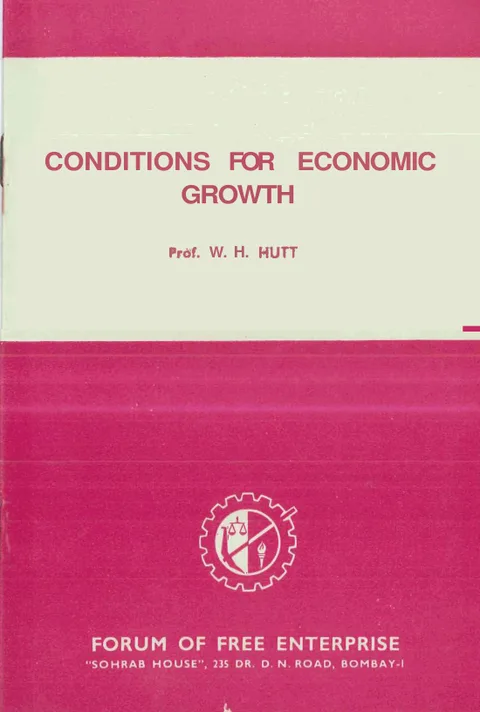
Conditions for Economic Growth
By W. H. Hutt
Published by M. R. Pai for the Forum of Free Enterprise, 235, Dr. Dadabhai Naoroji Road, Bombay 1, and Printed by S. J. Patel, at Onlooker Press, (Prop. Hind Kitabs Ltd.), Sassoon Dock, Colaba, Bombay-5. · Bombay · 1964
13 pages
Summary
Delivered as a Forum of Free Enterprise pamphlet dated 9 August 1964, W. H. Hutt’s Conditions for Economic Growth opens with the question of how India can most rapidly raise its average standards of living toward those of Western Europe and the United States, and answers it with a polemical inversion: altruistic foreign aid is of negligible importance compared with what private foreign profit-seekers, claiming no altruism whatever, would supply in capital, equipment and managerial competence if Indian policy permitted them entry under credible guarantees against nationalisation and confiscatory taxation. The ‘most formidable internal & imposed barrier’ to India’s catching up, Hutt insists, is not any want of Indian talent but the legal-political restraint placed on the inflow of foreign capital and on the institutions of a competitive market.
The pamphlet then enumerates conditions Hutt believes any under-developed economy must satisfy. Growth depends on thrift — both as physical capital accumulation and as the ‘human capital’ built up through education and technical training; discriminatory (‘progressive’) taxation and naively administered death duties destroy incentive, while properly administered death duties whose proceeds are channelled into income-yielding investment can equalise opportunity. The democratic role of the market is that the consumer, not the planner, disciplines producers; Hutt cites Mises’s ‘omnipotent government’ and Adam Smith’s never-refuted critique of import-tariff protection. Protective tariffs that screen domestic industry from cheaper foreign supply are condemned, with South Africa offered as a counter-example of industrial progress achieved without infant-industry protection. He couples this with the claim that industrial growth cannot be financed at agriculture’s expense — ‘a vigorous development of factory production nearly always requires a parallel development of agriculture’ — and proposes mechanisation of cultivation in parallel with industrialisation.
The later sections attack labour unions for using strikes and boycotts to enforce wage rigidities that prevent labour markets from clearing, and Western governments for relying on inflation as a politically easy substitute for genuine co-ordination. Hutt closes with a ten-point summary: a tax system that does not discriminate against the provident; faith for foreign capital secured by an official renunciation of nationalisation; explicit recognition of profit as the reward for wise direction; constitutional bars on race-, caste- and income-based discrimination; abolition of tariff and quota restraints; mechanisation of agriculture alongside industrialisation; resistance to grandiose public capital schemes; prohibition of private coercion over prices, wages and outputs (strikes and boycotts); renunciation of inflationary monetary policy; and prevention of unbridled population growth.
Key points
-
Hutt frames India’s task as how to most rapidly close the gap with Western Europe and the United States, and re-poses it as: why are powerful world forces spreading modern technology being prevented from reaching the Indian masses?
-
Foreign ‘aid’ from altruism or enlightened self-interest is treated as negligible relative to what self-interested foreign profit-seekers would deliver if permitted entry under credible guarantees against nationalisation and confiscatory taxation.
-
Thrift — including ‘human capital’ built through education and technical training — is identified as the foundation of growth; discriminatory (‘progressive’) taxation and badly administered death duties destroy incentives, while death-duty proceeds must be ‘maintained intact and devoted to the production of income-yielding assets’.
-
The chief obstacle to India’s modernisation is described as an internal, imposed barrier on the inflow of foreign capital, not any deficiency of Indian managerial talent.
-
Protective tariffs for infant industries are rejected with Adam Smith’s never-refuted arguments and a comparative appeal to South Africa, where industrial progress is said to have occurred without such protection.
-
Industrialisation and agricultural development are presented as inseparable: factory output cannot expand if farm productivity does not, and mechanisation of agriculture must proceed alongside industrial growth.
-
Labour unions are criticised for substituting collective coercion (strikes, boycotts) for free-market wage-rate adjustment, with resulting unemployment, regressive price pressure on the poor, and inequitable income distribution.
-
Inflation is named the chief contemporary weakness of Western policy — a politically convenient debasement that ‘controllers’ use in lieu of co-ordination — and Hutt calls for its renunciation.
-
The pamphlet closes with a ten-point programme covering taxation, foreign-capital guarantees, recognition of profit, constitutional anti-discrimination, removal of tariff/quota restraints, mechanisation of agriculture, restraint of grandiose public schemes, prohibition of private wage/output coercion, renunciation of inflation, and control of population growth.
Metadata and summary are AI-extracted from the source PDF and reviewed for editorial accuracy. The original work is available via the Read PDF tab above (where present); paragraph-level citation inside the PDF is deferred to a future engagement.