pamphlet
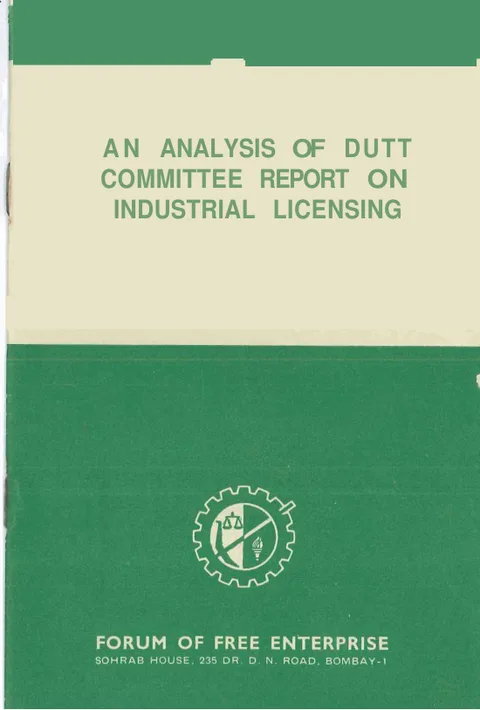
An Analysis of Dutt Committee Report on Industrial Licensing
By Forum of Free Enterpriseorganisation
Published by M. R. Pai for the Forum of Free Enterprise, 235, Dr. Dadabhai Naoroji Road, Bombay 1, and Printed by S. J. Patel, at Onlooker Press, (Prop. Hind Kitabs Ltd.), Sassoon Dock, Colaba, Bombay-5. · Bombay · 1969
13 pages
Summary
Published by the Forum of Free Enterprise in November 1969, this short booklet bundles two journalistic critiques of the Dutt Committee Report on Industrial Licensing. The first piece, by an unnamed “Special Correspondent” reproduced from the Indian Express, argues that the Committee’s loaded terms of reference produced a document whose summary recommendations do not flow from its own factual analysis. Marshalling the Committee’s own tables — the 23.8 per cent share of licences held by the 73 large houses and their second tiers, the 4.2 per cent share of the large independents, the 9.3 per cent and 6 per cent rates of non-implementation respectively — the correspondent contends that on every numerical criterion (share of licences, share of capital goods imports, rates of rejection and non-implementation) the large industrial sector performed at least as well as, and often better than, the rest of the private sector, the small-scale sector and the public sector. The villainising of “large houses” therefore rests on rhetoric rather than data, and the report’s failure to summon witnesses or examine demand-forecasting reflects a methodological vacuum that the Monopolies Bill and bank nationalisation have, in any case, already overtaken.
The analysis then turns to policy. It charges that the Committee ignored the role of demand variability, raw-material availability and the long lead-times between licensing and production; it accepts the case for a joint sector but warns that financial-institution directors cannot be expected to participate meaningfully in management; it notes that the recommendation for a “core sector” reserved to public undertakings contradicts the Industrial Policy Resolution and the Industrial Development Minister’s own statement on entrepreneurial freedom; and it argues that a rigid five-year ban on growth in the “middle sector” would suppress exports, raise prices and depress public revenues. Citing the Maharashtra Government’s SICOM scheme, the correspondent recommends positive incentives over blanket area bans, an independent judicial chairman for the licensing committee, and a high-quality monitoring committee under a retired Supreme Court judge.
The second piece, an editorial titled “Vintage in Small Pack” reproduced from the Economic & Political Weekly of 6 September 1969, takes a sharper tone. It complains that two years of labour have yielded a report unable to demarcate clearly between the “core” and “middle” sectors, that the Committee’s casual recommendation to plant public-institution directors on company boards betrays an outdated “pocket-sized” conception of control, and that neither technology nor organisation — the two factors most integral to size — receives any worthwhile attention. The editorial closes with the booklet’s central indictment: that the Committee has bequeathed more problems than it has solved, and that “its contribution is more academic. And that is a failure of mind.” Two epigraphs — Eugene Black on accepting private enterprise as an “affirmative good” and A. D. Shroff on the perpetuity of free enterprise — frame the booklet as a Forum statement of position rather than a neutral commentary.
Key points
-
The booklet packages two press critiques of the Dutt Committee Report — a Special Correspondent piece from the Indian Express and an Economic & Political Weekly editorial titled “Vintage in Small Pack”.
-
Central argument: the Committee’s summary recommendations do not flow from its own factual analysis; its conclusions “loaded” the case against large industrial houses in spite of data that exonerates them.
-
Statistical case: the 73 large houses and their second tiers accounted for only 23.8 per cent of licences and 9.3 per cent of non-implementation; large independents, only 4.2 per cent of licences and 6 per cent of non-implementation — performance at least as good as other sectors.
-
Methodological critique: the Committee did not summon witnesses, failed to address demand forecasting, the three-to-five-year lead-times between licensing and production, raw-material variability, or capacity definitions.
-
Policy critique: the recommended five-year ban on growth in the “middle sector” would damage exports and revenues; the Maharashtra SICOM model of positive incentives is preferred to blanket area bans.
-
On the joint sector: financial-institution nominees cannot meaningfully participate in management; modern control rests on investment, reporting and information systems, not on directors’ physical presence.
-
On the core sector: the Committee’s recommendation of state monopoly over basic and heavy industries contradicts the Industrial Policy Resolution and the Industrial Development Minister’s own pronouncements on entrepreneurial freedom.
-
Implementation reform: the licensing committee should be chaired by an independent judicial figure, ideally a retired Supreme Court judge, supported by a high-quality top-level monitoring committee.
-
The booklet positions itself as a Forum of Free Enterprise polemic — book-ended by Eugene Black’s epigraph defending private enterprise as an “affirmative good” and A. D. Shroff’s posthumous declaration on the perpetuity of free enterprise.
Metadata and summary are AI-extracted from the source PDF and reviewed for editorial accuracy. The original work is available via the Read PDF tab above (where present); paragraph-level citation inside the PDF is deferred to a future engagement.