
Summary
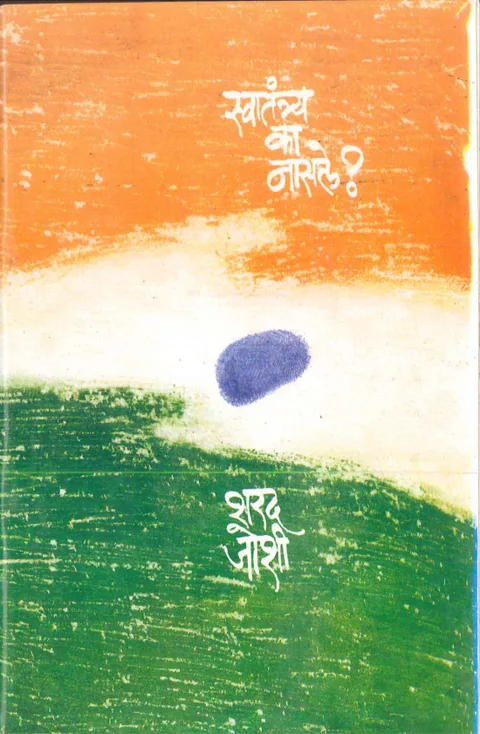
This Marathi-language book by Sharad Joshi, the farmer-leader and founder of the Shetkari Sanghatana, is a polemical reckoning published in December 1998 by Renuka Prakashan, Parbhani, on the occasion of the fiftieth anniversary of Indian independence. The title — Swatantrya ka Nasale? (“Did Independence Decay?”) — frames the central question: half a century after 15 August 1947, why has the promised dawn turned into stagnation, sectarian violence, agrarian distress, and a directionless economy? Joshi writes from his ashram at Angarmala (Ambethan, Pune district) and addresses readers in the wake of the Vajpayee government’s accession, the November 1998 state elections, the May 1998 Pokhran nuclear tests, and a wave of farmer suicides — events he treats as symptoms of a deeper political failure.
The book is organised as eleven essays (listed in the anukramanika): on the appointment with destiny, self-examination and self-deception, the various currents within the swaraj movement, “Bhataahi samajwad” (priestly socialism) in place of Gandhism, the loss of liberty after independence, savarna-convenient democracy, a “second partition,” the Chitragouri workshop, the train derailed, English rule continuing under a new guise, and the looting that began before the flag was even raised. Joshi advances a revisionist thesis: the Congress was always an urban, Westernised, propertied formation; its leadership inherited the colonial state and substituted a “Brahmanical socialism” for Gandhi’s village-and-Sarvodaya vision, sidelining peasants, Adivasis, Muslims, Dalits and women. He marshals comparative GDP figures (India’s per-capita against Korea, Singapore, Malaysia, Thailand, China, even Bangladesh) to argue that countries which were poorer than India in 1947 have left it behind, and that Nehruvian planning, licence-raj socialism, and now Hindutva-flavoured statism are continuous expressions of upper-caste bureaucratic rule. He calls for a “second republic” and a second freedom struggle — a constitutional refoundation in the name of the bahujan samaj. The book sits squarely in the liberal-cum-agrarian critique of post-1947 dirigisme that Joshi pioneered through the Shetkari Sanghatana and later the Swatantra Bharat Paksh.
Key points
- Sharad Joshi writes on the fiftieth anniversary of independence and asks bluntly whether freedom has decayed, treating the 1998 golden-jubilee celebrations as a hollow government ritual rather than popular festivity.
- He argues the Congress was from its founding an urban, Westernised, savarna formation, and that 1947 transferred power from the British to the same propertied Anglicised class rather than to the bahujan samaj.
- The book reframes Nehruvian socialism as ‘Bhataahi samajwad’ — a Brahmanical, priestly socialism that replaced Gandhi’s village economy and Sarvodaya with central planning, license-raj and bureaucratic rule.
- Joshi cites comparative per-capita incomes (Korea $10,656, Singapore $20,987, Malaysia $8,865, Thailand $7,104, China, even Bangladesh $1,331) to show countries once poorer than India have overtaken it after fifty years of planning.
- He surveys the multiple currents within the swaraj movement — feudal jahal ‘nationalists’ (the lineage running through Arya Samaj, Vivekananda, Hedgewar, Hindu Mahasabha, Jana Sangh, BJP, Shiv Sena, VHP), the urban Anglicised moderates, the Gandhian mass current, and the suppressed bahujan/Ambedkarite stream.
- Joshi reads contemporary events — the May 1998 Pokhran tests, the rise of Vajpayee’s BJP, communal violence after Babri/Kashmir, and waves of farmer suicides with revenue officials extorting families — as symptoms of the same upper-caste bureaucratic state continuing under new slogans.
- He calls for a ‘dusre ganaraajya’ (second republic) and a second freedom struggle, arguing that constitutional tinkering is not enough and that wholesale revision of the 1950 constitutional order is necessary.
- The polemic is anchored in Joshi’s own movement: written from Angarmala ashram, published from Parbhani, and addressed to the Shetkari Sanghatana’s audience of farmers, Adivasis, Muslims, women and Dalits whom he calls the real shoshit (exploited) classes.
Metadata and summary are AI-extracted from the source PDF and reviewed for editorial accuracy. The original work is available via the Read PDF tab above (where present); paragraph-level citation inside the PDF is deferred to a future engagement.