
Summary
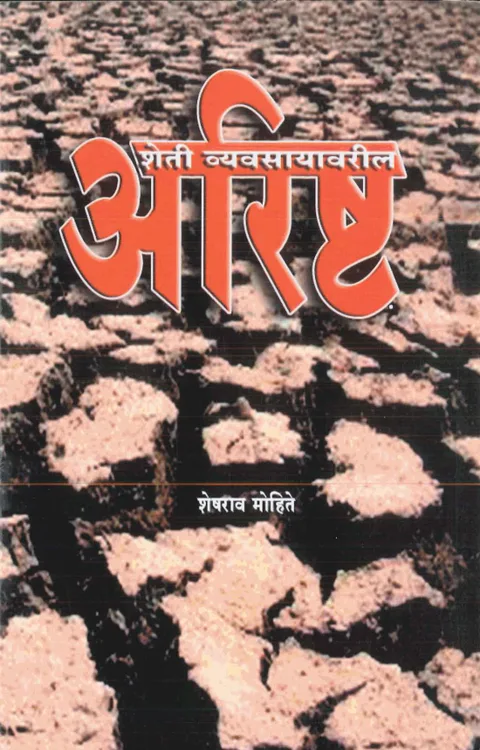
Sheti Vyavasayavaril Arishta (“The Crisis of the Farming Profession”) is a short Marathi-language tract by Dr. Shesharao Mohite, first published in December 2007 by Janashakti Vachak Chalwal, Aurangabad, with a second edition in November 2009. Mohite, a Marathwada-based writer associated with the Shetkari Sanghatana farmers’ movement led by Sharad Joshi, frames the book as a diagnosis of the wave of farmer suicides in Maharashtra and across India. He argues that the suicides are not isolated tragedies of weather, family quarrels, or alcoholism, but the predictable outcome of decades of state policy that have deliberately kept agricultural prices below the cost of production in order to subsidise urban consumers and industrial growth.
The book opens with a foreword by Amar Habib placing Mohite in the lineage of Jayaprakash Narayan’s Chhatra Yuva Sangharsh Vahini and the early 1980s onion and tobacco agitations of the Shetkari Sanghatana, and recalls the Parbhani convention of 1984. The main essay then traces the crisis historically: from Tukaram’s and Ramdas’s seventeenth-century laments about Maharashtra’s famines, through Jotiba Phule’s 1883 Shetkaryacha Asud, to Vitthal Ramji Shinde’s 1932 distinction between “India” and “Bharat”, to Nehruvian Five-Year Plans, the Green Revolution, the Agricultural Prices Commission, and the post-1991 liberalisation that, in Mohite’s view, exempted agriculture from genuine market freedom while continuing the older extraction.
Drawing on a 2005 Financial Express round table, Tata Institute of Social Sciences data placed before the Bombay High Court, and figures from the Planning Commission, Mohite shows how planners shifted outlays away from farming, how “negative subsidy” on thirteen major crops between 1980 and 2000 amounted to roughly three lakh crore rupees of extraction from cultivators, and how indebtedness to cooperative, rural and nationalised banks — not private moneylenders — has driven cotton-belt farmers in Vidarbha and Marathwada to suicide. The book is a compact polemic in the economic-liberal, pro-market tradition of the Shetkari Sanghatana: it asks for remunerative prices, an end to price controls, the right to sell freely, and an end to the planner’s habit of treating the farmer as a captive supplier to the city.
Key points
- Dr. Shesharao Mohite, a Latur-based academic and Shetkari Sanghatana activist, argues that farmer suicides in Maharashtra are caused primarily by indebtedness rooted in state-suppressed agricultural prices, not personal failings.
- The foreword by Amar Habib situates Mohite within the lineage of Jayaprakash Narayan’s Chhatra Yuva Sangharsh Vahini, the 1980 onion agitation, and the 1984 Parbhani convention of Sharad Joshi’s Shetkari Sanghatana.
- Mohite invokes Tukaram and Ramdas on the famines of 1628-29 and 1630, and Jotiba Phule’s 1883 Shetkaryacha Asud, to show that the extraction of surplus from cultivators long predates colonial rule but was perfected by the British and continued by independent India.
- He quotes Maithili Bhusnurmath of The Financial Express (2005 roundtable) to argue that post-1991 liberalisation has bypassed agriculture, leaving the sector under planner-style controls while the rest of the economy was freed.
- Vitthal Ramji Shinde’s 1932 distinction between “India” and “Bharat” is identified as the conceptual seed that Sharad Joshi later turned into the Shetkari Sanghatana’s central slogan.
- Citing V. T. Krishnamachari, Norman Borlaug’s 1980 Bangalore warning, and the Agricultural Prices Commission set up under C. Subramaniam and later chaired by Annasaheb Shinde, Mohite shows that successive governments admitted but never corrected the policy of pricing farm output below cost.
- He calculates that on thirteen major crops between 1980 and 2000 farmers suffered a “negative subsidy” of roughly three lakh crore rupees, while accumulated farm debt stood at about 33,000 crore — making the much-publicised relief packages of 1,750 crore (December 2005) and 6,000 crore (Vidarbha) derisory.
- Tata Institute of Social Sciences data on 644 suicides between March 2001 and December 2004, presented to the Bombay High Court via journalist Prakash Pohare of Deshonnati, show that 86% of suicides were of small, mostly cotton-growing, dryland farmers indebted to cooperative and nationalised banks rather than private moneylenders.
- Mohite closes with Julian Simon’s argument that human ingenuity flourishes only under freedom, and contends that India’s farmer will revive only when agriculture is released from state price controls and planning-board tutelage.
Metadata and summary are AI-extracted from the source PDF and reviewed for editorial accuracy. The original work is available via the Read PDF tab above (where present); paragraph-level citation inside the PDF is deferred to a future engagement.