
Summary
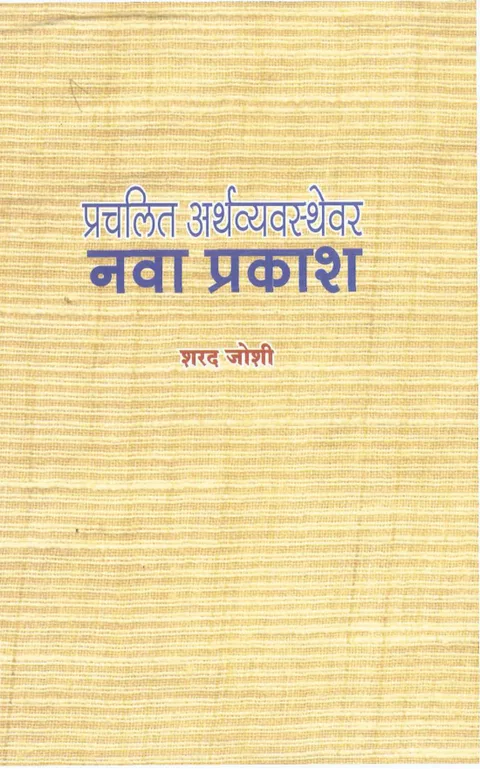
This Marathi-language volume by Sharad Joshi, founder of the Shetkari Sanghatana (farmers’ organisation), collects his political-economic essays first published as ‘Prachalit Arthavyavsthevar Nava Prakash’ (A New Light on the Prevailing Economic System) by Shetkari Prakashan in December 1982, together with the 1985 sequel ‘Prachalit Arthavyavsthevar Nava Prakash Bhag 2’. The combined edition was reissued in 2009 by Janashakti Vachak Chalwal, Aurangabad, with Shrikant Umrikar as publisher. Most of the essays originally appeared in the weekly ‘Varakari’ and in the Shetkari Sanghatana’s organ between 1980 and the early 1980s. They cover Indira Gandhi’s return to power in the 1980 elections, the Antulay government’s 49-crore farm loan waiver, the 1979 Lonavla seminar on political instability, drought, agricultural price policy, election strategy and the moral foundations of the farmers’ movement.
Joshi’s central thesis, set out in the preface and the opening essay, is that India is in fact two countries — ‘Bharat’, the impoverished rural economy of indebted peasants and agricultural labourers, and ‘India’, the urban industrial sector built on the colonial-era extraction of cheap raw materials and cheap food from the countryside. Independence in 1947 simply transferred the colonial machinery from British hands to a domestic urban elite; ‘we exchanged white Englishmen for black Englishmen.’ Mainstream economics, both Nehruvian planning and orthodox capitalism, treats agriculture as a reservoir to be milked for industrial capital formation, denying farmers the exchange value their produce deserves. Joshi argues that the only way out is to give agricultural commodities remunerative prices (‘bhik nako, ghamache daam pahije’ — not alms, but the price of our sweat), thereby breaking the unequal terms of trade between Bharat and India.
The collection moves from this framing into sharp polemics against the intelligentsia (whom Joshi accuses of intellectual poverty for endorsing fashionable diagnoses of political instability while ignoring the agrarian question), critiques of the Agricultural Prices Commission as a ‘butcher’s knife’, commentary on the Rajiv Gandhi years, and reflections on the Nipani and Chandigarh agitations, the 2000 farmer, and the moral-philosophical basis of the Shetkari Sanghatana. Together the pieces form one of the foundational statements of the Indian agrarian-liberal tradition that insists on free, remunerative markets for farm produce as the precondition of genuine independence.
Key points
- Sharad Joshi divides post-1947 India into ‘Bharat’ (the exploited rural economy) and ‘India’ (the urban industrial beneficiary of colonial-style extraction), arguing that political independence did not end internal colonialism.
- The book’s rallying slogan, ‘bhik nako, ghamache daam pahije’ (not alms, but the price of our sweat), frames the Shetkari Sanghatana’s demand for remunerative agricultural prices as a poverty-removal strategy.
- Joshi attacks both Nehruvian planning and orthodox industrial-capitalist development for treating agriculture as a reservoir of cheap inputs to be drained for urban capital formation.
- An early essay, ‘Indira India Zhali, Bharatacha Vali Kon?’ (Indira has become India, who will protect Bharat?), reads the January 1980 Lok Sabha victory of Indira Gandhi as a continuation of urban-biased policy that ignores the 70 percent of Indians who are dryland farmers.
- The chapter ‘49 Kotinchi Karjamafi’ criticises Maharashtra Chief Minister A.R. Antulay’s June 1980 announcement waiving Rs 49 crore of farm loans as a political gimmick that leaves the underlying unprofitability of agriculture untouched.
- ‘Vicharvantanche Buddhidaaridraya’ attacks the December 1979 Lonavla seminar convened by V.M. Dandekar and others on political instability, arguing that the intelligentsia diagnosed moral decline while ignoring the agrarian roots of the crisis.
- Joshi calls the Agricultural Prices Commission a ‘kasabacha kasab’ (butcher’s craft) for systematically setting farm-gate prices below cost of production, citing an average shortfall of around 47 percent.
- The collection includes pieces on the Nipani tobacco agitation, the Chandigarh movement, drought, election strategy, and the ‘moral philosophy’ of the Shetkari Sanghatana, framing the farmers’ movement as a complete worldview rather than a sectional grievance.
Metadata and summary are AI-extracted from the source PDF and reviewed for editorial accuracy. The original work is available via the Read PDF tab above (where present); paragraph-level citation inside the PDF is deferred to a future engagement.