
Summary
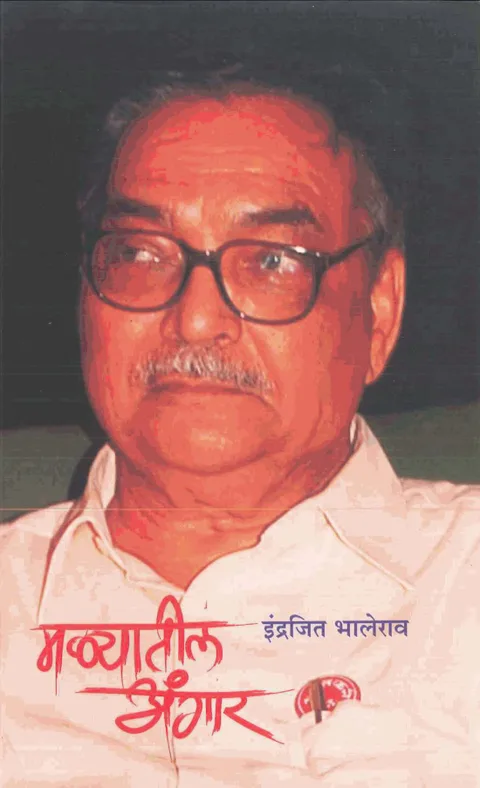
Despite the catalogued title attributing it to Sharad Joshi, this Marathi-language book — Malyatil Angar (“Embers in the Field”) — is actually written by the well-known Marathi poet Indrajit Bhalerao about Sharad Joshi and the Shetkari Sanghatana (Farmers’ Organisation). Published in January 2010 by Janshakti Vachak Chalwal in Aurangabad, with a foreword by Shrikant Umrikar, it collects four long essays in which Bhalerao recounts his decades-long engagement, as a peasant-born poet, with Joshi’s farmer movement in Maharashtra.
The essays — ‘Sharad Joshi, Shetkari Sanghatana ani Mazhi Kavita’ (Sharad Joshi, the Farmers’ Organisation, and My Poetry), a piece on the book ‘Angarmala’, a note on ‘Shetkaryancha Raja Shivaji’, and a longer history titled ‘Yoddha Shetkari’ (The Warrior Farmer) — trace how Bhalerao first encountered Joshi’s economic ideas in the early 1980s through Sarvodaya activist Gangaprasadji Agrawal at Vasmat’s Bahirji Smarak Mahavidyalaya, attended the Parbhani conventions of 1984, and gradually absorbed Joshi’s argument that India’s rural distress was caused by deliberately suppressed farm prices and policy-engineered terms of trade against agriculture. The author repeatedly contrasts Joshi’s rigorous agrarian-economics framework — including his advocacy of globalisation as a route to freeing the Indian farmer from a domestic anti-peasant regime — with his own more emotional, village-rooted sympathy for the same cause.
Written in plain, conversational Marathi prose, the book functions both as a literary memoir and as an oral-history record of how Joshi’s liberal, market-oriented critique of Nehruvian agricultural policy reached small towns of Marathwada through study circles, public rallies, Kojagiri poetry nights and literary conferences. Bhalerao places Joshi alongside Bhaskar Chandanshiv, Vinay Hardikar, Amar Habib, Sheshrao Mohite, Shrikant Deshmukh and Anant Umrikar as one of the few writers who carried the Shetkari Sanghatana’s ideas into Marathi literature, and frames the movement as a distinct strand within India’s broader liberal tradition — one that spoke for the cultivator against the planned economy.
Key points
- The book is written by Marathi poet Indrajit Bhalerao about Sharad Joshi and the Shetkari Sanghatana, not by Sharad Joshi himself.
- Published in Aurangabad on 1 January 2010 by Janshakti Vachak Chalwal, with a foreword by Shrikant Umrikar dated the same day.
- It collects four essays: on Joshi and the author’s poetry, on the book ‘Angarmala’, a note on ‘Shetkaryancha Raja Shivaji’, and a longer history titled ‘Yoddha Shetkari’.
- Bhalerao recounts being drawn into the movement in 1983 via Sarvodaya activist Gangaprasadji Agrawal at Bahirji Smarak Mahavidyalaya in Vasmat, and attending the Parbhani convention of February 1984.
- He distinguishes two ways of understanding the movement — Joshi’s rigorous agricultural-economics theory of globalisation and farmer freedom, and the villager’s emotional sympathy that Bhalerao himself represents.
- The essays describe how Joshi argued that centuries of farmer suffering stemmed from policy-imposed unfavourable terms of trade, and how he framed this as a freedom-from-the-state argument.
- Bhalerao names Bhaskar Chandanshiv, Vinay Hardikar, Amar Habib, Sheshrao Mohite, Shrikant Deshmukh and Anant Umrikar as the small group of writers who carried the Shetkari Sanghatana into Marathi literature.
- The text records the Joshi-led Marathwada Sahitya Sammelan at Jawalabazar (1996) and the Shetkari Sahitya Sammelan at Islampur (1998), positioning farmer literature as a wing of the liberal-agrarian movement.
Metadata and summary are AI-extracted from the source PDF and reviewed for editorial accuracy. The original work is available via the Read PDF tab above (where present); paragraph-level citation inside the PDF is deferred to a future engagement.