
Summary
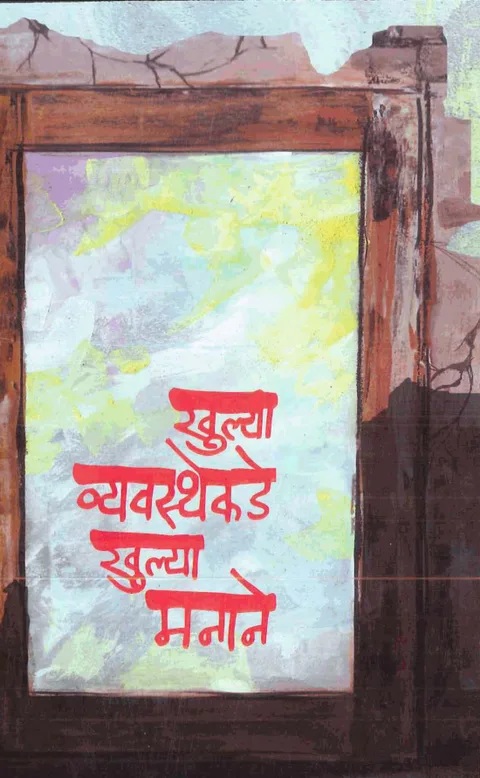
This Marathi-language book, ‘Khulya Vyavasthekade Khulya Manane’ (Toward an Open System with an Open Mind), collects essays by Sharad Joshi, the founder of the Shetkari Sanghatana (Farmers’ Organisation) of Maharashtra. The subtitle clarifies the scope: essays on the free-market economy and the GATT agreement. Originally published by Janshakti Vachak Chalwal / Janshakti Books and Publications (Aurangabad), the first edition appeared on 8 November 2003 and the second edition (the one rendered here) on 3 September 2008. The publisher’s note by Shrikant Umrikar explains that the volume gathers pieces Joshi wrote between 1991 and 1998 in the Shetkari Sanghatak fortnightly, with selection help from Dr. Sham Ashtekar and Ajit Narde, and editorial support from Sureshchandra Mhatre, Vinay Hardikar and Anant Umrikar. An appendix titled ‘Swatantryachi Mulye’ (Values of Freedom) accompanies the main collection.
The book argues that India’s 1991 liberalisation and the 1995 entry into the WTO/GATT framework were necessary and overdue, and that Sharad Joshi was — from the very start, when most opinion was suspicious — an unwavering advocate of globalisation and the open economy. The opening essay, ‘Naane Nidhi — Ek Shevgyache Jhaad’ (The IMF — A Drumstick Tree), attacks Nehruvian economics: the cult of state-led industrialisation, licence-permit raj, subsidies, exchange controls and the bureaucratic protection of inefficient public-sector factories. Joshi rejects the framing of ‘Bharat versus India’ in which an exploitative urban-industrial ‘India’ has been built on the back of an immiserated agricultural ‘Bharat’.
Subsequent chapters develop a sharp critique of fertiliser subsidies (which, he shows, end up in the pockets of fertiliser manufacturers rather than farmers), the cooperative sugar and dairy lobbies, the three-headed budget, the Dunkel draft and the French and Indian peasant responses to it, the WTO as battlefield, and the prospects of an open economy for Indian farmers. The closing pieces include ‘Asadhya te Sadhya Karita Sayas’ and reflective essays such as ‘Vyakti-vikas idam, na alam?’. Throughout, Joshi insists that genuine reform requires dismantling the Nehruvian framework root and branch, and that farmers will only prosper when the state stops suppressing agricultural prices and lets them trade freely at home and abroad.
Key points
- The collection gathers Sharad Joshi’s columns from the Shetkari Sanghatak fortnightly written between 1991 and 1998, framed around liberalisation and the GATT/WTO debate.
- Joshi presents himself as a consistent champion of globalisation and the open economy from the very start of the 1991 reforms, when most Indian opinion was suspicious of them.
- The opening essay likens the IMF to a ‘shevga’ (drumstick) tree that locals were forced to chop down to survive — a metaphor for the painful but necessary dismantling of Nehruvian economics.
- Nehruvian industrialisation is portrayed as a Western-imitative project that built urban ‘Chaitragauri’ showpiece factories on capital extracted from looted farmers.
- Fertiliser subsidies (around 4,500 crore rupees by the early 1990s, rising toward 7,000 crore) are shown to flow mainly to fertiliser manufacturers rather than to the farmers in whose name they are justified.
- The cooperative sugar industry and the dairy cooperative model (including Sumul and Kurien-style schemes) are criticised for absorbing ‘Bharat’ into ‘India’ on terms that disadvantage primary producers.
- Joshi argues that Manmohan Singh’s stabilisation through IMF loans and gold sales is only a saline drip, not a cure, and that the political-economic order of licences, controls and bureaucratic price-suppression must be fully replaced.
- Separate chapters address the Dunkel draft and the contrasting Indian and French farmer reactions to it, the WTO as ‘dharmakshetra-kurukshetra’, and the longer-term prospects of small-farm agriculture under an open trading regime.
- An appendix, ‘Swatantryachi Mulye’ (Values of Freedom), grounds the policy essays in a broader liberal-philosophical framework of individual freedom and rule of law.
Metadata and summary are AI-extracted from the source PDF and reviewed for editorial accuracy. The original work is available via the Read PDF tab above (where present); paragraph-level citation inside the PDF is deferred to a future engagement.