
Summary
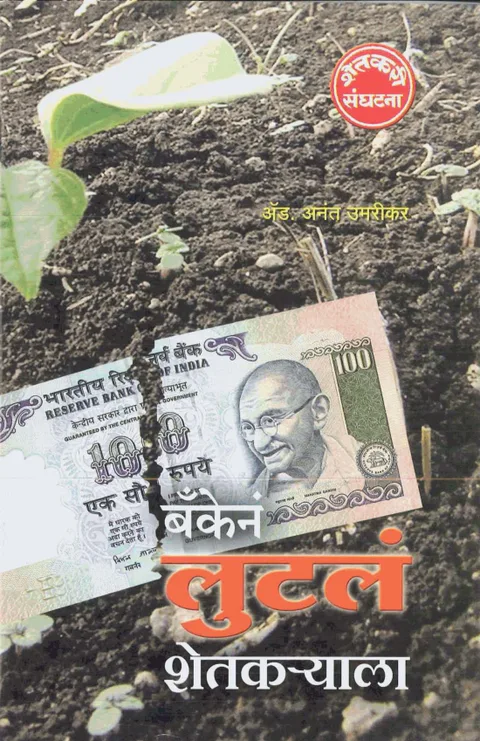
This short Marathi-language book (the title translates roughly as ‘The Banks Have Looted the Farmer’) is a polemical legal-economic tract by Adv. Anant Umrikar, a lawyer-activist associated with Sharad Joshi’s Shetkari Sanghatana (the farmers’ organisation). First published on 10 December 2005 (Shetkari Hutatma Din, Farmers’ Martyrs’ Day) in Parbhani by Janashakti Vachak Chalwal, the book is in its fourth edition (2009) and was reissued to mark the silver jubilee of the Sanghatana. It carries a Shetkari Sanghatana imprint on the cover, which shows a Gandhi-era hundred-rupee note lying on freshly tilled soil.
The argument is narrow, technical, and angry. Umrikar contends that for more than three decades India’s commercial and rural banks have illegally overcharged Indian farmers on agricultural loans by compounding interest at quarterly or half-yearly rests, in direct violation of binding RBI circulars (14 March 1972, 17 August 1976, 28 February 1978, 15 September 1984) and Section 21 of the Banking Regulation Act 1949. The circulars, reproduced as an English-language appendix at the back, expressly forbid compounding on current crop loans because farmers earn lumpy income only at harvest. The Supreme Court’s 1994 ruling in Karnam Rangarao vs. Bank of India and the related Corporation Bank vs. D.V.S. Gowda judgement confirmed this principle, and Justices A.M. Ahmadi and S.C. Agarwal made the directive binding on all banks. Umrikar argues that despite the law, the RBI, and the courts, banks continued the practice and looted billions of rupees from farmers over roughly 32-33 years.
The book opens with a vivid case study from Sheni village in Nanded district, Marathwada, where the Marathwada Gramin Bank turned a Rs. 90,000 tractor loan to one Shri Dhumal into an Rs. 18-lakh recovery decree and tried to auction his land. Umrikar narrates how Shetkari Sanghatana activists (under Sou. Shobhatai Waghmare and Shri Gunpati Patil) physically blockaded the auction, faced SC/ST Atrocities Act counter-cases, and forced the bank to back down — illustrating how legal entitlements mean nothing without organised resistance. The work sits squarely in the Sharad Joshi tradition of Indian liberal-agrarian thought: it treats the farmer as a producer trapped not by markets but by a hostile state-banking-judicial apparatus, and demands that the loot already extracted be refunded and recycled into a low-interest farm credit corpus.
Key points
- The book accuses Indian banks of decades of illegal compounding of interest on agricultural loans in violation of RBI circulars and Section 21 of the Banking Regulation Act 1949.
- It reproduces four RBI circulars (1972, 1976, 1978, 1984) as English-language appendices and cites them as the central evidence that quarterly/half-yearly rests on crop loans are forbidden.
- The opening case study from Sheni village, Nanded, describes how a Rs. 90,000 Marathwada Gramin Bank tractor loan to farmer Shri Dhumal ballooned to an Rs. 18-lakh court decree, prompting a Shetkari Sanghatana blockade of the auction.
- Sanghatana activists led by Sou. Shobhatai Waghmare and Shri Gunpati Patil were charged under the SC/ST Atrocities Act for opposing the auction, which the author calls a casteist misuse of the law against the organisation that had earlier honoured Ambedkar and Phule.
- The author cites the Supreme Court’s 1994 ruling in Karnam Rangarao vs. Bank of India and the Corporation Bank vs. D.V.S. Gowda judgement (Justices Ahmadi and Agarwal) as binding precedent that banks ignored.
- Umrikar quotes Sharad Joshi’s slogan ‘Shetkaryanche maran heech shasanaachi dhoran’ (the death of the farmer is the policy of the state) to frame banking as one more arm of state predation.
- The book demands that the cumulative excess interest extracted from farmers over 32-33 years be repaid and used to seed a permanent low-interest agricultural credit fund.
- It situates itself in the silver-jubilee politics of the Shetkari Sanghatana (Parbhani, 10 December 2005) and is dedicated to the cause of farmer-debtor liberation through legal-constitutional remedies.
Metadata and summary are AI-extracted from the source PDF and reviewed for editorial accuracy. The original work is available via the Read PDF tab above (where present); paragraph-level citation inside the PDF is deferred to a future engagement.