
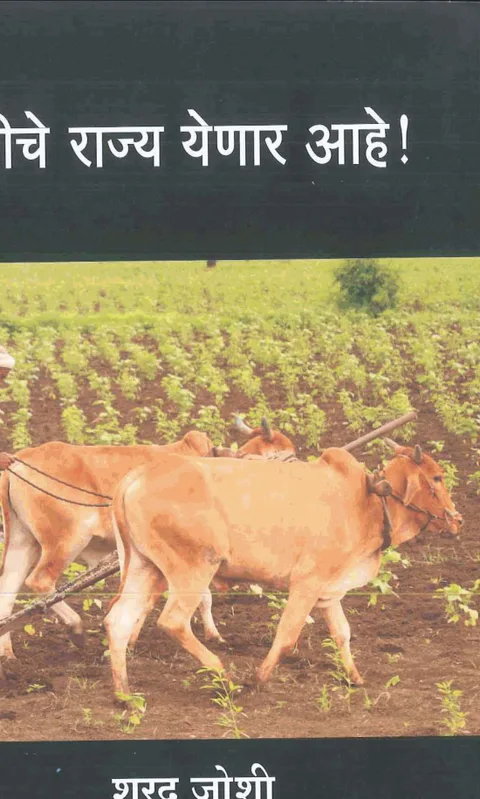
Summary
This Marathi-language volume, ‘Baliche Rajya Yenar Aahe!’ (‘The Kingdom of Bali Is Coming!’), is a substantial collected-writings compendium by Sharad Joshi, the agronomist-turned-organiser who founded the Shetkari Sanghatana and led the most influential farmers’ movement in independent India. Published in October 2010 by Janshakti Vachak Chalwal (Aurangabad) on the occasion of Joshi’s amrutmahotsavi (75th) birth year, the volume gathers essays, speeches and movement-period interventions stretching from his earliest 1979 piece in the weekly ‘Warkari’ to writings from the 1989–2000 high-tide of the Sanghatana. The book is organised into four parts — Chintan (reflection), Andolan (movement), Sahakar (cooperation and the sugar/cotton/dairy/credit-society complex) and Karjabali (the debt-toll and farmer suicides) — followed by an appendix titled ‘Shetkaryanchi Sanghatana: Adachani aani Marg’ (The Farmers’ Organisation: Obstacles and the Road Ahead).
The opening essay sets the analytical frame that runs through the collection: the development of industry in India, as in eighteenth-century England and Stalin’s Soviet Union, was financed by squeezing the peasantry. Joshi rehearses the Corn Laws debate, the Bukharin–Preobrazhensky controversy and Stalin’s brutal resolution of it, then maps the same logic onto Nehruvian planning — the wholesale price index, PL-480 grain dumping, ration controls, the Mahalanobis-style preference for heavy industry — all of which, in his telling, kept Indian farm-gate prices artificially low so that cheap food could subsidise urban wage-earners and the new industrial class. Gandhian self-sufficiency, he argues bitingly, was conscripted only as a ‘battering ram’ by the very mercantile and industrial interests it was meant to resist.
Later chapters move from this macro critique into concrete agitations: the cotton monopoly scheme, the sugar co-operatives (‘Sakhar Samrajya’ / sugar empire), fertiliser pricing, water and Maharashtra’s Mahableshwar lobby, the demand for a farmers’ ‘Marshall Plan’, the manifesto of farmers’ freedom (Shetkari Swatantryacha Jahirnama), and the wave of debt-driven suicides in Yavatmal and elsewhere. The closing essays issue a call — ‘Baliraja, ata tujha tevadha aadhar’ — for the awaited Kingdom of Bali, Joshi’s invocation of an older agrarian sovereignty in which the cultivator is no longer the colony of the city.
Key points
- The volume is a ‘collected works’ tribute compiled for Sharad Joshi’s 75th birth-year in October 2010 by Janshakti Vachak Chalwal, Aurangabad, gathering writings from 1979 through the 1989–2000 peak of the Shetkari Sanghatana.
- Joshi’s central thesis is that Indian industrialisation — like England’s and Stalinist Russia’s — was financed by transferring surplus out of agriculture through deliberately suppressed farm-gate prices.
- The opening essay ‘Annadatyala puresa khau dya, to jagala potbhar khau ghalil’ (‘Let the food-giver eat his fill and he will feed the world a bellyful’) reconstructs the Bukharin–Preobrazhensky debate and Stalin’s liquidation of Bukharin as a warning against extractive ‘socialist’ farm policy.
- Nehruvian planning, the wholesale price index, PL-480 American grain imports and ration controls are read as a continuous system that kept cultivators poor to subsidise the urban industrial economy.
- Joshi argues that Gandhian khadi-and-village rhetoric was instrumentalised by the new industrial-mercantile class — ‘used only as a battering ram’ — while real power passed to Nehruvian planners.
- A long section on Sahakar dissects the sugar ‘empire’, cotton monopoly procurement, the Mahableshwar water lobby and the Mumbai milk-cooperative complex as instruments that turned cooperatives against the very farmers they claimed to serve.
- The Karjabali (‘debt sacrifice’) section addresses farmer suicides directly — chapters titled ‘Mara, maru naka’, ‘Yavatmalche dukhne’ and ‘Annadatyala aas pranadanachi’ — and rejects loan-waiver-and-subsidy palliatives in favour of remunerative prices.
- The book ends with the title invocation ‘Baliche rajya yenar aahe’ / ‘Baliraja, ata tujha tevadha aadhar’, framing the farmers’ movement as the return of an older agrarian sovereignty against the city-state.
Metadata and summary are AI-extracted from the source PDF and reviewed for editorial accuracy. The original work is available via the Read PDF tab above (where present); paragraph-level citation inside the PDF is deferred to a future engagement.