
Summary
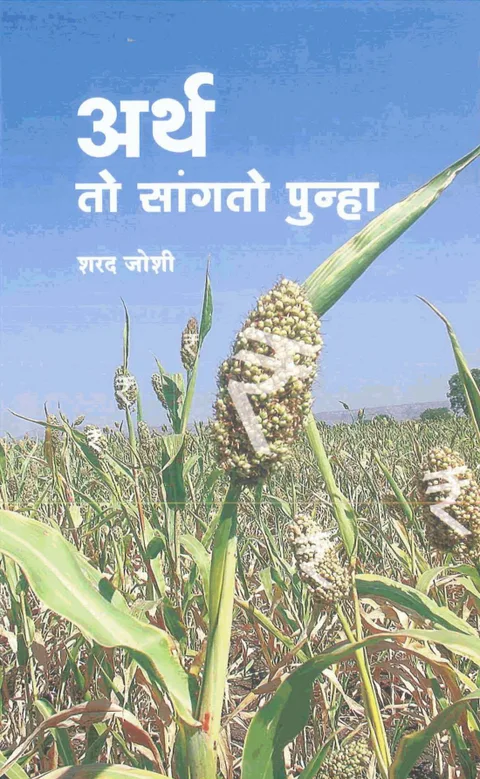
This Marathi-language book, Artha To Sangto Punha (“Economics, I Say Again”), is a thematic collection of Sharad Joshi’s writings on Indian economic policy, drawn from his columns and speeches over roughly two decades and published by Janshakti Vachak Chalwal of Aurangabad in 2010. The publisher’s note by Shrikant Anant Umrikar explains that the editors gathered seventy-four of Joshi’s essays from Shetkari Sanghatak (the Shetkari Sanghatana fortnightly), Loksatta, Lokmat, Deshonnati and The Hindu Business Line, and split them into two companion volumes: one focused on agriculture, reserved seats, small states and social questions (published as Bharatasathi), and this one focused on the macro questions of finance, industry, trade and labour. The title plays on Joshi’s signature framing — that he is once again explaining the economics India refuses to learn.
The book opens with a sustained polemic against the late-1980s National Front budget delivered by Madhu Dandavate in March 1990, which Joshi treats as the first occasion on which India’s rural-supported government had a chance to overturn forty years of Nehruvian planning and squandered it. The early chapters dissect Dandavate’s loan-waiver scheme as a ‘tutpunji’ (penny-pinching) populist gesture that benefits bank clerks more than farmers, attacks the IMF terms accepted by Narasimha Rao and Manmohan Singh in 1991, mocks the new industrial policy as a ‘Singapore model’ that still protects Tata-Birla-Kirloskar-style domestic monopolists, and accuses the bureaucracy of capturing the supposed liberalisation. Joshi’s recurring frame is the ‘India versus Bharat’ divide: urban industrial ‘India’ has been subsidised for forty years on the back of agricultural ‘Bharat,’ and even reform-era budgets continue that transfer.
Later chapters in the table of contents track the budgets of Chidambaram, Yashwant Sinha and Pranab Mukherjee through to 2006-07, return repeatedly to farmer indebtedness and the ‘willful defaulter’ slur, and argue for remunerative prices, freedom from licence-permit-quota residues, and 14 percent agriculture-led growth. Throughout, Joshi writes as the founder-theorist of the Shetkari Sanghatana, addressing a Marathi rural audience in a sharp, scornful, deeply numerate idiom — and positions himself as the Indian liberal tradition’s most uncompromising voice for the peasant against the planner.
Key points
- Collects 74 of Sharad Joshi’s Marathi essays from Shetkari Sanghatak, Loksatta, Lokmat, Deshonnati and translated Hindu Business Line columns, edited by Shrikant Anant Umrikar for Janshakti Vachak Chalwal, Aurangabad, 2010.
- Companion volume to Bharatasathi: this book carries the macro-economic essays on finance, industry, trade and labour, while the other carries agriculture and social-policy pieces.
- Opens with a scathing reading of Madhu Dandavate’s March 1990 National Front budget, calling the much-trumpeted Rs 10,000 farm-loan waiver a tokenistic ‘tutpunji’ gesture that mostly benefits bank staff and excludes the genuinely indebted small farmer.
- Attacks the 1991 IMF-conditioned borrowing accepted under Narasimha Rao and Manmohan Singh, arguing that forty years of Nehruvian planning, not foreign debt itself, is the real disease and that devaluation and deficit-cutting alone will not cure it.
- Dismisses the July 1991 New Industrial Policy as a ‘Singapore model’ that quietly preserves protection for Tata, Birla, Kirloskar and other domestic industrial houses while pretending to liberalise.
- Frames Indian political economy as ‘India versus Bharat’ — an urban-industrial ‘India’ subsidised for four decades on the back of agricultural ‘Bharat’ — and accuses every post-1991 finance minister of continuing that transfer.
- Rejects the label of ‘willful defaulter’ applied to indebted farmers, insisting that the real cause of rural default is the state’s refusal to give agricultural produce a remunerative price.
- Argues that 14 percent GDP growth led by agriculture is feasible, that licence-permit-quota residues and a captured bureaucracy must be dismantled, and that the Shetkari Sanghatana’s village-level agitations are the only real check on policy.
Metadata and summary are AI-extracted from the source PDF and reviewed for editorial accuracy. The original work is available via the Read PDF tab above (where present); paragraph-level citation inside the PDF is deferred to a future engagement.