
Summary
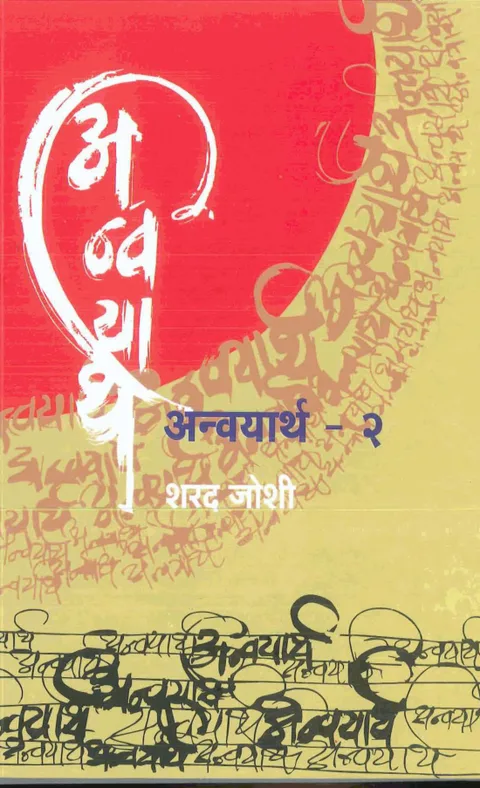
This Marathi-language book, Anvyaarth - 2 (अन्वयार्थ - २) by Sharad Joshi, is the second volume in a collected-essays series published by Janshakti Vachak Chalwal (Aurangabad) on 16 March 2010 to mark the author’s amrit-mahotsav (75th-birth anniversary). It gathers 67 short commentary pieces that Joshi originally wrote under his ‘Anvyaarth’ column in the Marathi daily Dainik Lokmat across two clusters of years: 1992-1994 and 2000-2001. Each essay is dated, so the reader can place the argument in its political and economic context. A companion volume, Anvyaarth - 1, covers the 1993-1994 pieces; this second volume extends the project into the late-1990s and the WTO-era debates of 2000-2001.
Joshi, the founder of the Shetkari Sanghatana farmers’ movement, opens with a long Prastaavik (preface) in which he traces the Sanghatana’s evolution since 1978 — from the Chakan onion agitation and the 1980 Nashik sugarcane stir to the demand for remunerative prices based on production costs, the campaign for ‘sampurna karjmukti’ (total loan waiver), the critique of subsidy regimes, and the 1997 Amravati Jansansad that articulated the ‘India versus Bharat’ framework on its fiftieth-anniversary terms. He insists that the Sanghatana’s worldview is not narrowly peasant but a general philosophy of economic freedom, market access, and freedom from state interference, with a distinctive embrace of new technology and a measured critique of environmentalist opposition to it.
The essays themselves range across globalisation and the WTO, Bill Clinton’s March 2000 visit to the subcontinent (‘Vyaapaar kara, yuddh nako’ — Trade, not war), Kashmir and the CTBT, the Emergency, Kargil and Pakistan, the Gujarat earthquake, the Narmada agitation, Nepal’s royal massacre, Osama bin Laden and 9/11, Vajpayee’s coalition politics, Murli Manohar Joshi’s education policy, and recurring meditations on rural distress, MSP, technology in agriculture, and the persistence of the licence-permit raj. The tone is that of a polemical liberal columnist applying a free-market, anti-statist lens to contemporary Indian events.
Key points
- Second volume of Sharad Joshi’s collected ‘Anvyaarth’ columns from Dainik Lokmat, covering 1992-1994 and 2000-2001, published 16 March 2010 by Janshakti Vachak Chalwal, Aurangabad.
- The preface narrates the Shetkari Sanghatana’s history from the 1978 Chakan onion agitation and 1980 Nashik sugarcane stir through the demand for cost-based remunerative prices and ‘sampurna karjmukti’ (total farm-loan waiver).
- Joshi argues that the Sanghatana’s ‘India versus Bharat’ framework, formalised at the 1997 Amravati Jansansad, is a general doctrine of economic freedom rather than a sectional peasant ideology.
- He defends new agricultural technology against Malthusian and environmentalist objections, observing that food output rose because farmers adopted new methods on the same land.
- The opening essay ‘Vyaapaar kara, yuddh nako’ analyses Bill Clinton’s March 2000 subcontinent tour, the CTBT, Kashmir, and the post-Pokhran nuclear standoff, arguing trade openness matters more than the Kashmir question.
- Essays cover the WTO Marrakesh accords, labour-cost arbitrage between rich and poor countries, and Jagdish Bhagwati’s caution on linking labour and environment clauses to trade agreements.
- Later pieces address Murli Manohar Joshi’s education policy, the Gujarat earthquake, the Narmada andolan, the Nepalese royal massacre, Osama bin Laden, the Kargil war, and Atal Bihari Vajpayee’s coalition politics.
- Joshi treats his column as ‘laghu-nibandh’ (short essays) that still read meaningfully a decade later, and frames the volume as the philosophical extension of the Shetkari Sanghatana’s economic argument into non-agricultural domains.
Metadata and summary are AI-extracted from the source PDF and reviewed for editorial accuracy. The original work is available via the Read PDF tab above (where present); paragraph-level citation inside the PDF is deferred to a future engagement.