
Summary
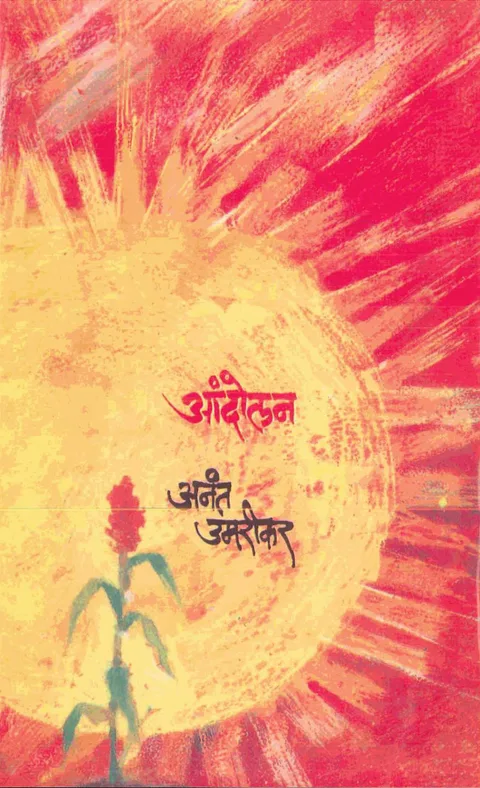
Andolan (Marathi for ‘Movement’) is a Marathi-language collection of four long autobiographical and reportorial essays by Anant Umarikar, a lawyer-activist from Parbhani in the Marathwada region of Maharashtra. First published in August 1992 by Janshakti Vachak Chalwal (Aurangabad) and reissued in a revised third edition in July 2008, the book is dedicated to Sharad Joshi, founder of the Shetkari Sanghatana (Farmers’ Organisation). Umarikar writes from inside the movement: he was a district-level karyakarta who helped organise the Sanghatana’s pivotal Parbhani convention and its later agitations, and the four essays — ‘Paule Chalti Parbhanichi Vaat’ (Footsteps Walking the Parbhani Road), ‘Andolan’ (Movement), ‘Chandvadachya Vatevar’ (On the Road to Chandvad) and ‘Kapus Raktalala’ (The Cotton Turned Red) — together form a participant’s chronicle of the Shetkari Sanghatana’s rise across Marathwada in the early 1980s and the cotton-monopoly agitations that followed.
The political argument the book carries is the Sharad Joshi line that the author calls a defence of mukta arthavyavastha — the free-market economy — against the dirigiste consensus of the time. In the preface (Manogat) Umarikar notes that Marathi literature has only thinly registered the Shetkari Sanghatana’s thinking on free markets, and that the views the movement advances against the prevailing Indian economic orthodoxy are ‘also our views, even when they go against the grain’. The third edition, he writes, is offered to a new generation that is once again curious about the farmers’ movement and the free-market arguments of the preceding decades, on the eve of the Sanghatana’s Aurangabad convention. Essays from his earlier volume ‘Vaatchaal’ are folded in.
The opening essay reconstructs the Parbhani organising work of 1983–84 in granular detail: Sarvodaya veteran Prasadji of Vasmat drawing the young lawyer in; the local karyakarta network around Bhaskarbhau Borawake, Shrirangrao More, Sheshrao Mohite and the Krishi Vidyapeeth students; the door-to-door propaganda on bicycles from villages around Parbhani; the building of a fourteen-foot Sharad Joshi cut-out and a forty-foot stage on the Marathwada Prashala grounds; and the February 1984 inter-state Kisan Samanvay Samiti meeting that drew delegates from Punjab, Haryana, Gujarat, Andhra, Karnataka and Madhya Pradesh. Folk-style ballads composed for Joshi are quoted at length. The texture is reminiscence rather than tract — small portraits of jahagirdars, journalists, students and Congress-versus-BJP village politics — but the cumulative case is that the farmers’ agitation was the seedbed in Maharashtra for what the author frames as an indigenous free-market politics.
Key points
- The book is a four-essay Marathi memoir of the Shetkari Sanghatana years by Anant Umarikar, a Parbhani lawyer and movement insider, dedicated to Sharad Joshi.
- First edition August 1992 from Janshakti Vachak Chalwal in Aurangabad; the third, revised edition (Parbhani, 7 July 2008) absorbs essays from Umarikar’s earlier volume ‘Vaatchaal’.
- The preface explicitly frames the Shetkari Sanghatana’s position as a defence of mukta arthavyavastha (free-market economy) against the dominant Indian economic orthodoxy.
- The opening essay ‘Paule Chalti Parbhanichi Vaat’ chronicles the building of the Sanghatana’s first Marathwada convention at Parbhani, including the inter-state Kisan Samanvay Samiti meeting of February 1984 with delegates from Punjab, Haryana, Gujarat, Andhra, Karnataka and Madhya Pradesh.
- Umarikar names the local cadre — Bhaskarbhau Borawake, Shrirangrao ‘Nana’ More, Prasadji of Vasmat, Sheshrao Mohite, Anil Gote, Pratap Wangar, B. L. Tamaskar — and Sanghatana leaders including Madhav Khanderao More, Prahlad Patil Karad and Ramchandra Bapu Patil.
- Long Marathi ‘bharud’ folk-ballads in praise of Sharad Joshi (‘Sharad Joshi aale, aata Sharad Joshi aale’) are reproduced as documentary evidence of the movement’s vernacular reach.
- The later essays extend the chronicle to the Chandvad women-farmers convention and to the ‘Kapus Raktalala’ cotton agitations, framing them as continuations of the same free-market campaign for remunerative crop prices.
- By 2008 Umarikar reflects with some melancholy that the original triumvirate of Sharad Joshi, Madhav Khanderao More and Prahlad Patil Karad has fragmented and that several first-generation karyakartas have drifted from the Sanghatana.
Metadata and summary are AI-extracted from the source PDF and reviewed for editorial accuracy. The original work is available via the Read PDF tab above (where present); paragraph-level citation inside the PDF is deferred to a future engagement.