
book · collected works
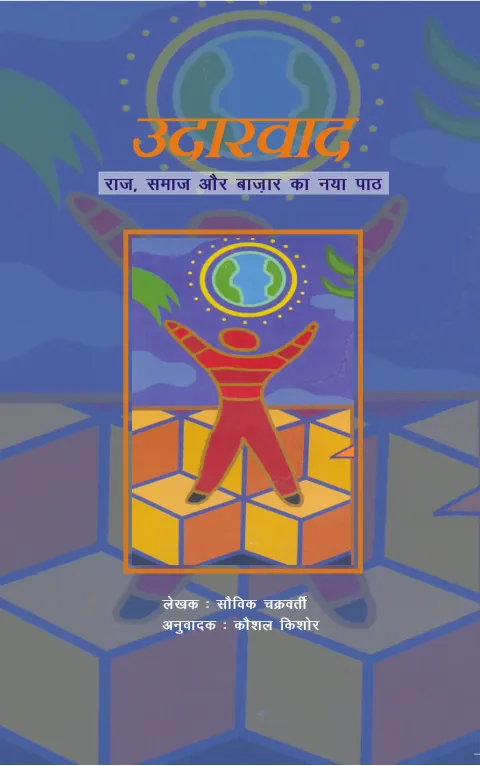
उदारवाद
राज, समाज और बाज़ार का नया पाठ
उदारवाद : राज, समाज और बाज़ार का नया पाठ
Udārvād: Rāj, Samāj aur Bāzār kā Nayā Pāṭh
सेंटर फॉर सिविल सोसाइटी · New Delhi · 2006
97 pages
Summary
This Hindi-language book is Kaushal Kishore’s translation of Sauvik Chakraverti’s primer ‘Free Your Mind’, published by the Centre for Civil Society (CCS), New Delhi, in 2006 under the title ‘Udarwad: Raj, Samaj aur Bazaar ka Naya Paath’ (Liberalism: A New Reading of State, Society and Market). Chakraverti, a former IPS officer turned journalist and senior assistant editor at the Economic Times, was a prominent Indian classical-liberal popularizer and a winner of the Frederic Bastiat Prize awarded by International Policy Network, London. The translator, Kaushal Kishore, is a teacher-educator at Jagadguru Rambhadracharya Handicapped University, Chitrakoot, who came into contact with CCS in 2003.
The book is explicitly addressed to citizens of the world’s largest constitutional democracy, with a particular eye on young readers (roughly age fourteen and up) before they reach voting age. Its premise is that government-prescribed civics and economics textbooks teach Indians the worldview the socialist state wants them to internalize, leaving them unable to see contemporary reality clearly. The introduction names three pillars of a free society — the political freedom of democracy, the economic freedom of the free market, and a liberal education that teaches the value of freedom — and argues that India has secured only the first. India’s ranking of 120th in the 1999 World Economic Freedom Index, in the ‘mostly unfree’ / ‘economically repressed’ category, is presented as the proximate cause of mass poverty.
Organized into eighteen short, illustrated chapters with ‘Just Think’ prompts, the work walks readers through the human capacity for exchange (‘Homo Economicus’), the case that population density is a source of prosperity through division of labour, the failure of political markets, the tragedy of public property, free trade, sound money (in two chapters), employment, poverty, the environment, the future of bureaucracy, knowledge, public assets, ethics and secularism, freedom and equality, politics, and principles of sound public policy. A closing chapter introduces CCS itself. The tone is pedagogical and Bastiat-influenced, urging readers to test received wisdom against reality rather than accept what state-approved curricula tell them.
Key points
- The book is the authorized Hindi translation of Sauvik Chakraverti’s ‘Free Your Mind’, published by Centre for Civil Society, New Delhi, in 2006 with funding support acknowledged to Dr. Parth J. Shah and Manali Shah.
- Author Sauvik Chakraverti is identified as a former IPS officer and senior assistant editor at the Economic Times, holder of MA degrees from Delhi University and the London School of Economics, and recipient of the Frederic Bastiat Prize from International Policy Network, London.
- The introduction names three pillars of a free society — political freedom (democracy), economic freedom (free markets), and a liberal education that teaches the value of freedom — and argues India has only the first.
- Chakraverti cites India’s 120th rank in the 1999 World Economic Freedom Index, placing it among ‘mostly unfree’ and ‘economically repressed’ economies, as the central cause of widespread Indian poverty.
- The book targets young readers around fourteen years of age, before they gain voting rights, on the premise that state-prescribed textbooks indoctrinate citizens into socialist assumptions about politics and economics.
- Chapter 2 argues that population is a cause of prosperity, not poverty: dense settlements enable deeper division of labour, which is why Delhi, Mumbai, London, Tokyo, New York and Paris are rich while self-sufficient villages remain poor.
- Self-sufficiency is described as a form of ‘economic suicide’ that wastes productive energy in tasks one is not specialized in, and is contrasted with market exchange built on specialization.
- The eighteen-chapter table of contents covers political market failure, the tragedy of public property, free trade, sound money, employment, poverty, environment, bureaucracy, knowledge, ethics and secularism, freedom and equality, politics, and principles of sound public policy, closing with an overview of CCS itself.
- An epigraph quoting Abraham Lincoln’s letter to his son’s teacher frames the book as a tool for testing all received information against the touchstone of truth.
Metadata and summary are AI-extracted from the source PDF and reviewed for editorial accuracy. The original work is available via the Read PDF tab above (where present); paragraph-level citation inside the PDF is deferred to a future engagement.