
periodical issue
Khoj : September - October, 2010
Pahel — Initiative for Open Society, Vadodara · 2010
44 pages
Summary
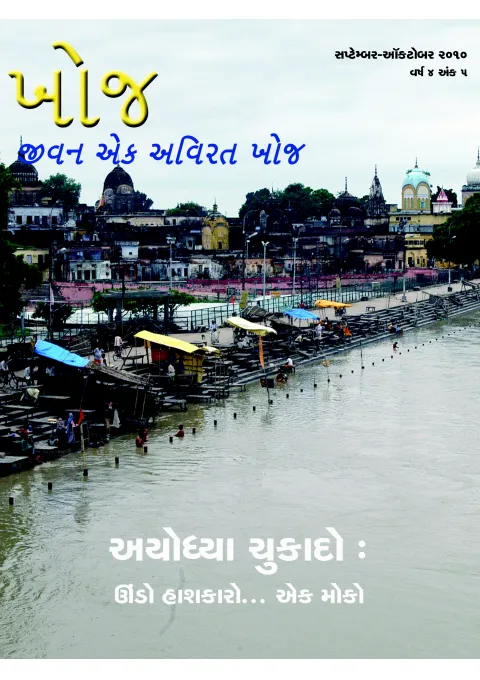
This is the September-October 2010 issue (Year 4, Issue 5) of Khoj, a Gujarati-language bimonthly periodical published from Vadodara and edited by Ambrish Mehta, with Trupti Parekh, Anil Patel and Rajesh Mishra on the editorial board. The subtitle ‘Jivan ek Avirat Khoj’ (life is a ceaseless seeking) frames the magazine as a forum for liberal, rationalist enquiry, and the masthead is regularly opened by epigraphs from the Rig Veda and Xenophanes that insist truth is provisional and human knowledge a ‘woven web of guesses’. This issue is dominated by the Allahabad High Court’s 30 September 2010 verdict on the Babri Masjid - Ram Janmabhoomi title suit, announced just as the magazine went to press.
The editorial by Ambrish Mehta and the long lead essay ‘Ayodhya Chukado: Sarvatra Undo Hashkaro… Ek Moko’ by Rajesh Mishra read the three-judge ruling - which declared Hindus, Muslims and the Nirmohi Akhada joint title-holders and partitioned the disputed site into three parts - as a procedural triumph for Indian democracy rather than a doctrinal one. They argue the real gain is that an explosive 1528-rooted dispute was carried through courts without renewed bloodshed, quote Justice Khan and Justice Dhavan, canvas reactions from Hashim Ansari, Javed Anand, Javed Akhtar, Saeeda Hameed and others, and urge both Hindu and Muslim communities to treat the verdict as a ‘watershed’ and refuse the bait laid by hardliners on both sides. A companion piece by Jaswant B. Mehta cites the Istanbul precedent of the Hagia Sophia turned museum as a model for converting contested religious sites into secular civic spaces.
The rest of the issue extends Khoj’s standard liberal preoccupations. Ambrish Mehta reports on the Gujarat High Court granting bail to seven Adivasi activists framed in Surat’s ‘Naxal’ case, defending the right to possess radical literature; Nandan Nilekani (translated from his foreword to James Tooley’s The Beautiful Tree) and Gurcharan Das (from Sunday Times) make a forceful free-market case for low-fee private schools serving the poor and against the Right to Education Act’s shuttering of unrecognised slum schools; Ashwinkumar Karia analyses the legal vacuum around ‘honour killings’ and khap panchayats; Wajahat Habibullah, Saeeda Hameed and Asghar Ali Engineer write on Kashmir; Gajendrasinh Jadeja examines Sardar Patel’s foreign-policy outlook; and Bakula Ghaswala profiles the 1840-born reformer Bibi Ashraf.
Key points
- September-October 2010 issue of Khoj, a Gujarati liberal bimonthly edited by Ambrish Mehta out of Vadodara, framed by Rig Veda and Xenophanes epigraphs on the provisional nature of truth.
- Lead coverage is the Allahabad High Court’s 30 September 2010 Ayodhya verdict partitioning the disputed Babri Masjid - Ram Janmabhoomi site three ways between Hindus, Muslims and the Nirmohi Akhada.
- Editor Ambrish Mehta and Rajesh Mishra read the ruling as a watershed for Indian democracy because a 1528-rooted dispute was resolved through courts without fresh violence, and urge both communities to refuse hardliner mobilisation.
- Jaswant B. Mehta proposes the Hagia Sophia museum in Istanbul as a model for converting the Ayodhya site into a non-sectarian public space.
- Ambrish Mehta reports the Gujarat High Court granting bail to seven Adivasi activists - Makabhai Chaudhari, Jayaram Goswami, K.N. Singh, Vishwanath Ayer, Ramu Puwar, Satyamrav and Niranjan Mahapatra - framed in Surat’s ‘Naxal’ case, with the court defending the right to possess literature.
- Nandan Nilekani’s foreword to James Tooley’s The Beautiful Tree is translated to argue that low-fee private schools run by slum entrepreneurs serve the poor better than government schools.
- Gurcharan Das, reprinted from the Sunday Times (19/9/2010), attacks the Right to Education Act for forcing the closure of unrecognised budget private schools that the poor actually choose and pay for.
- Ashwinkumar Karia surveys the legal and constitutional gaps around ‘honour killings’ and khap panchayat sanctions following Punjab and Haryana High Court observations.
- Further essays cover Kashmir (Wajahat Habibullah, Saeeda Hameed, Asghar Ali Engineer), Sardar Patel’s foreign-policy outlook (Gajendrasinh Jadeja), and a profile of the 1840-born Muslim woman reformer Bibi Ashraf by Bakula Ghaswala.
Metadata and summary are AI-extracted from the source PDF and reviewed for editorial accuracy. The original work is available via the Read PDF tab above (where present); paragraph-level citation inside the PDF is deferred to a future engagement.