
periodical issue
Khoj : September - October, 2007
Pahel — Initiative for Open Society, Vadodara · 2007
48 pages
Summary
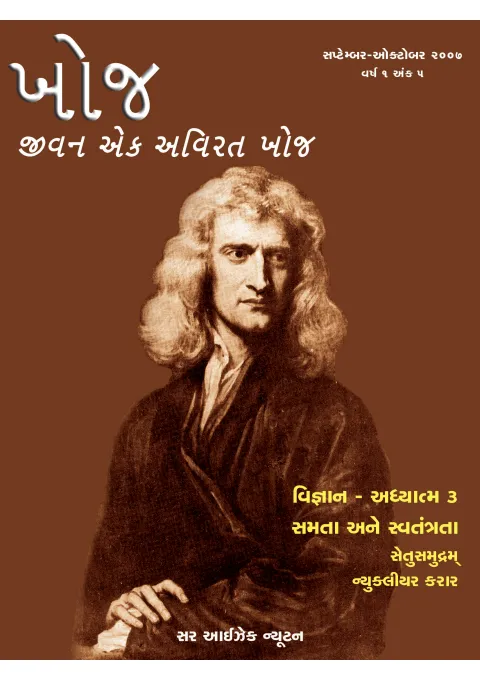
This is the September-October 2007 issue (Year 1, Issue 5) of Khoj (“Quest” — with the tagline “Jivan Ek Avirat Khoj”, meaning “life is a ceaseless quest”), a Gujarati-language periodical edited by Ambrish Mehta and published from Arch, Mangrol (Narmada district), Gujarat. The cover features a portrait of Sir Isaac Newton, signalling the issue’s preoccupation with the relationship between modern science and Indian spiritual traditions. The magazine is associated with Action Research in Community Health and Development (ARCH), and its editorial board includes Trupti Parekh, Anil Patel, Rajesh Mishra and others active in Gujarat’s civil-society and liberal-reform circles.
The issue’s centrepiece is the third installment in an ongoing series titled “Vigyan-Adhyatm” (“Science-Spirituality”), with a long reply-essay by Anil Patel and substantial reader responses from Pragnyabhai Dave (Jamnagar), Shilaben (Brahma Vidya Mandir, Pavnar) and others. The debate ranges over the epistemological status of mystical experience, the role of the observer in quantum mechanics (Niels Bohr, Heisenberg, the Copenhagen interpretation), J. Krishnamurti’s notion of “pure observation”, Fritjof Capra’s The Tao of Physics and The Turning Point, and whether spiritual “truth” can meet the universality and falsifiability standards demanded of scientific knowledge. A second editorial-length essay, “Samta ane Svatantrata” (“Equality and Freedom”), reports on an August 24-27 thought-camp at Mangrol attended by activists from Jharkhand and elsewhere, where the role of markets versus the state in delivering equality was hotly debated.
The “Samprat Samasya” (current affairs) section carries topical pieces on the Indo-US nuclear deal (T.S. Gopi Rethinaraj), the Sethusamudram shipping-channel project (Trupti Parekh), the ASI’s controversial affidavit on Ram Setu (Jaykrishna Nair), and Burma’s Saffron Revolution. Kirit Panwala contributes a long, lawyerly critique titled “Yakub Memon mate kon aansu sarshe?” (“Who will shed tears for Yakub Memon?”) rebutting Masih Rahman’s Indian Express article and walking through the evidentiary standards under the Indian Evidence Act, TADA and CrPC for assessing the 1993 Mumbai bomb-blasts convictions. Mukesh Edanwala’s English-language piece “Swatantrata - Jnan ane Bazaar” debates Anilbhai on whether market institutions automatically secure development, citing A. Lanyi on institutions as “rules of the game”. A regular column “Tamara man ne mukt karo” by Saumitra Chakravarti and a Gujarati translation of Leonard Read’s “I, Pencil” round out the issue.
Key points
- September-October 2007 issue of Khoj, a Gujarati periodical edited by Ambrish Mehta and published by ARCH from Mangrol, Narmada district.
- Cover features Isaac Newton, framing the third installment of the magazine’s running “Vigyan-Adhyatm” (Science-Spirituality) debate.
- Long reply-essay by Anil Patel engages Niels Bohr, Heisenberg, the Copenhagen interpretation, J. Krishnamurti and Fritjof Capra’s The Tao of Physics and The Turning Point on the limits of mystical knowledge.
- Editorial “Samta ane Svatantrata” reports on an August 2007 thought-camp at Mangrol attended by Sangharsh Vahini and Jharkhand activists debating the role of markets versus the state.
- Kirit Panwala’s piece “Yakub Memon mate kon aansu sarshe?” defends Justice Kode’s TADA judgment in the 1993 Mumbai bomb-blasts case against Masih Rahman’s Indian Express article, arguing the circumstantial-evidence and conspiracy law was correctly applied.
- Current-affairs section covers the Indo-US nuclear deal (T.S. Gopi Rethinaraj), the Sethusamudram project (Trupti Parekh), the ASI’s Ram Setu affidavit (Jaykrishna Nair) and Burma’s Saffron Revolution.
- Mukesh Edanwala’s English essay “Swatantrata - Jnan ane Bazaar” debates Anilbhai on whether market mechanisms automatically deliver development, citing A. Lanyi’s definition of institutions as the “rules of the game”.
- The issue carries a Gujarati translation of Leonard E. Read’s classic free-market essay “I, Pencil”, anchoring the periodical’s liberal-economic orientation.
Metadata and summary are AI-extracted from the source PDF and reviewed for editorial accuracy. The original work is available via the Read PDF tab above (where present); paragraph-level citation inside the PDF is deferred to a future engagement.