
periodical issue
Khoj : November - February, 2006
Pahel — Initiative for Open Society, Vadodara · 2006
52 pages
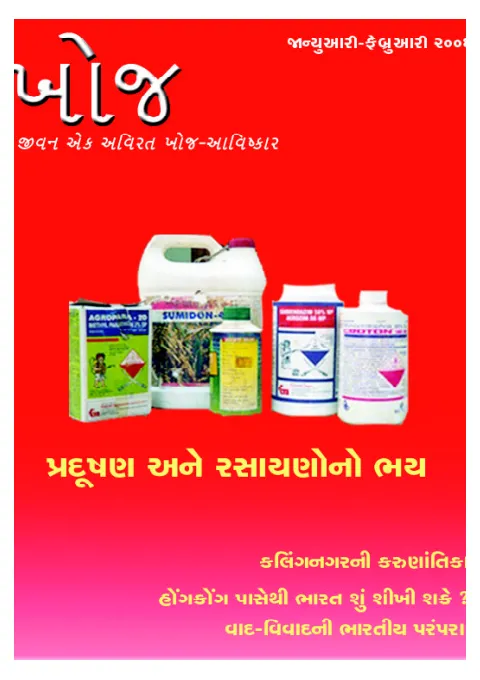
Summary
This is a combined November 2005 - February 2006 issue (Volume 1, Issues 5-6) of Khoj, a Gujarati-language bimonthly periodical edited by Ambrish Mehta and published from Fategunj, Vadodara by the Arch (Initiative for Open Society) centre. The editor explains in an apology note that production delays forced the combination of the two issues into a single double number. The masthead lists an editorial board including Trupti Parekh, Anil Patel and Rajesh Mishra, with an advisory committee that includes well-known Gujarati civic figures such as Rashmi Kapadia, Daksha Patel, Sudarshan Iyengar, Kirit Khanwala, Aparna Kadikar, Nimisha Shukla and Parth Shah.
The issue opens with an editorial on whose shoulders India’s accelerating GDP growth is being carried, taking the Kalinganagar police firing on Odisha adivasis (January 2006) as the year’s defining moment and warning that forced acquisition of tribal land for industry cannot be sold as development. The longest piece is the fourth instalment of Anil Patel’s serialised essay “Swatantrata - Gnyan ane Bajaar” (Liberty, Knowledge and the Market), subtitled “Rule of Law versus Legal Positivism - the rise of socialism.” It is essentially a Gujarati synthesis of Hayek, Popper, Hume, Adam Smith and Karl Menger - tracing how British liberalism’s rule-of-law tradition gave way on the continent to Rousseauian popular sovereignty, Bismarckian state planning and finally legal positivism, which the author identifies with Kelsen’s “Pure Theory of Law” and treats as the intellectual root of totalitarianism.
Other articles cover the implications of the Kalinganagar tragedy and the 2005 Scheduled Tribes Forest Rights Bill (both by Trupti Parekh), “What can India learn from Hong Kong?” by Barun Mitra of the Liberty Institute, a fourth piece in Ambrish Mehta’s “Sceptical Environmentalist” series on pesticide and chemical pollution, a Gujarati abridgement of Amartya Sen’s introduction to The Argumentative Indian, short essays on church-state distance by Ashwin Karia and on atheist-theist bridges by Gautam Thakar, plus a “Charcha ni Eran” (Anvil of Debate) discussion column and a translated extract from Karl Popper titled “Buddhinishtha” (Rationalism). The issue is firmly positioned within the classical-liberal / Hayekian wing of Indian public thought.
Key points
- Combined Nov-Dec 2005 + Jan-Feb 2006 double issue of Khoj, a Gujarati bimonthly edited by Ambrish Mehta and published by Arch (Initiative for Open Society), Fategunj, Vadodara.
- Editorial frames 2006 as the year India’s 7 percent growth rate must be interrogated through the lens of the January 2006 Kalinganagar police firing on adivasis in Odisha.
- Anil Patel’s 40-page serialised essay ‘Liberty, Knowledge and the Market - 4’ argues that Continental legal positivism (Kelsen, Rousseau) destroyed the British rule-of-law tradition and paved the road to socialism and totalitarianism.
- Patel’s piece draws heavily on Hume, Adam Smith, Hayek (spontaneous order vs. organisations, catallaxy, the invisible hand) and Karl Popper’s critique of induction and historicism.
- Barun Mitra of the Delhi-based Liberty Institute contributes an essay asking what India can learn from Hong Kong’s free-market model.
- Trupti Parekh writes two pieces, one on the lessons of the Kalinganagar tragedy and another on the 2005 Scheduled Tribes (Forest Rights) Bill.
- Ambrish Mehta’s fourth ‘Sceptical Environmentalist’ instalment, titled ‘Pradushan ane Rasayano no Bhay’ (The Fear of Pollution and Chemicals), pushes back against the claim that pesticide use is fuelling a cancer epidemic.
- The issue carries a Gujarati condensation of Amartya Sen’s introduction to The Argumentative Indian alongside shorter pieces on secularism, atheist-theist dialogue and a translated Karl Popper extract on rationalism.
Metadata and summary are AI-extracted from the source PDF and reviewed for editorial accuracy. The original work is available via the Read PDF tab above (where present); paragraph-level citation inside the PDF is deferred to a future engagement.