
periodical issue
Khoj : November - December, 2009
Pahel — Initiative for Open Society, Vadodara · 2009
52 pages
Summary
This is the November-December 2009 issue (Year 3, Issue 6) of Khoj, a Gujarati-language bi-monthly magazine edited by Ambrish Mehta and published from Vadodara by Arch (a community health and development trust). The masthead tagline ‘Jeevan ek avirat khoj’ (Life is a continuous search) is paired on the frontispiece with verses from the Rig Veda and from Xenophanes, signalling the journal’s sceptical, inquiring temperament. This particular number doubles as a five-year anniversary issue: the editor’s note reflects on completing five years of regular publication, on the magazine’s modest circulation of around 450 subscribers, on its dependence on the Kachnar Trust of Vadodara, and on its self-defined mission to be a platform where people of differing viewpoints can debate rationally the problems of ordinary, especially marginalised, Indians.
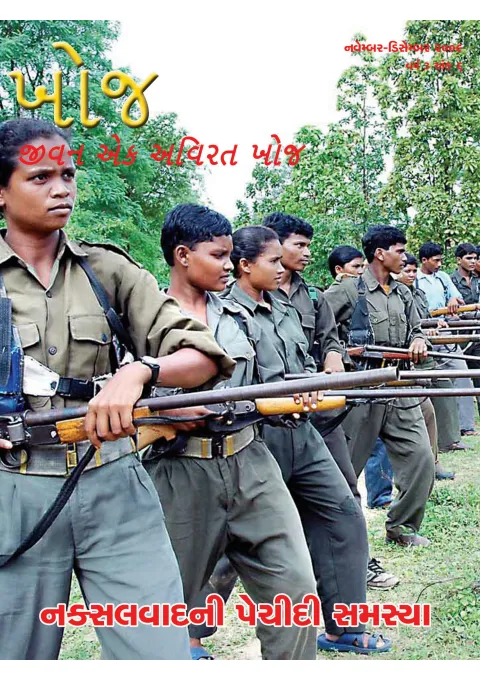
The issue’s cover story is Naxalism (the cover photograph shows a line of armed tribal cadres), examined in two long pieces — ‘Maovadi padkar’ (The Maoist challenge) by Trupti Parekh and Ambrish Mehta, and ‘Naxalvad’ by Chakravarti Ashok Priyadarshi — that locate the insurgency in the failure of the Indian state to deliver land, forest rights, and basic governance to adivasis. Around this anchor sit responses to earlier articles (Jagdishbhai Desai on workers’ safety and the free market, with Ambrish Mehta marshalling Milton Friedman’s ‘Free to Choose’ and OSHA accident-rate data to argue that competitive labour markets, not regulation, drove the long fall in workplace deaths; and a long rejoinder by Vasudev Vora on Dharampal’s ‘The Beautiful Tree’ and the case for decentralised, mother-tongue primary schooling against a centralised state system).
Other features include Rajesh Mishra on Gujarat’s new compulsory voting law (read as cosmetic rather than substantive electoral reform, given liquor-fuelled panchayat elections in Kawant and Chhota Udepur), Trupti Parekh on the Ruchika case and the abuse of police power, Pratap Bhanu Mehta on the Mumbai attacks, Ismail Gandhi on Vande Mataram, Gajendrasinh Jadeja on Hyderabad’s accession, Ashwinkumar Karia on separating police powers, and Vinaba Bhave arguing that the education system, like the press, should be independent of the state. The issue closes with a five-year cumulative index. Throughout, Khoj’s stance is recognisably classical-liberal: sceptical of statism, attentive to adivasi and worker agency, and committed to argument over slogan.
Key points
- November-December 2009 issue (Year 3, Issue 6) of the Gujarati bi-monthly Khoj, edited by Ambrish Mehta and published from Vadodara, marking the magazine’s fifth year of continuous publication.
- Cover package on Naxalism features two long essays — ‘Maovadi padkar’ by Trupti Parekh and Ambrish Mehta and ‘Naxalvad’ by Chakravarti Ashok Priyadarshi — framing the insurgency as a consequence of state failure on adivasi land and forest rights.
- Ambrish Mehta’s ‘Workers’ safety and the free market’ rebuts Jagdishbhai Desai by invoking Milton Friedman’s ‘Free to Choose’ (1980) and US National Safety Council data on occupational accident deaths to argue that employer competition, not OSHA, drove safety gains.
- Vasudev Vora’s response to the May-June 2009 piece on Dharampal’s ‘The Beautiful Tree’ surveys five Uttar Buniyadi and twenty-five government primary schools in Bhavnagar and Jamnagar to argue for decentralised, mother-tongue ‘neighbourhood school’ education.
- Rajesh Mishra’s ‘Talieti…’ column dissects Gujarat’s compulsory voting law through panchayat-election violence in Kawant taluka (Vadodara district), including assaults on sarpanch Jayantibhai Rathwa, and judges the law a cosmetic gesture rather than real electoral reform.
- The masthead pairs a Rig Veda invocation (‘Aa no bhadrah kratavo yantu vishvatah’) with Xenophanes’ fragment on truth as ‘a woven web of guesses’, signalling the magazine’s sceptical, inquiry-based editorial stance.
- Editorial discloses operating economics: roughly 450 subscribers, subscription revenue covering about 50% of costs, 25% from donations, 25% absorbed as loss, with sustaining support from Vadodara’s Kachnar Trust.
- Shorter pieces include Trupti Parekh on the Ruchika molestation case (‘She could be our daughter’), Pratap Bhanu Mehta on the Mumbai attacks, Ismail Gandhi on Vande Mataram, Gajendrasinh Jadeja on Hyderabad’s 1948 accession, and Vinaba Bhave arguing that education, like the judiciary and press, should be insulated from government control.
Metadata and summary are AI-extracted from the source PDF and reviewed for editorial accuracy. The original work is available via the Read PDF tab above (where present); paragraph-level citation inside the PDF is deferred to a future engagement.