
periodical issue
Khoj : May - June, 2009
Pahel — Initiative for Open Society, Vadodara · 2009
48 pages
Summary
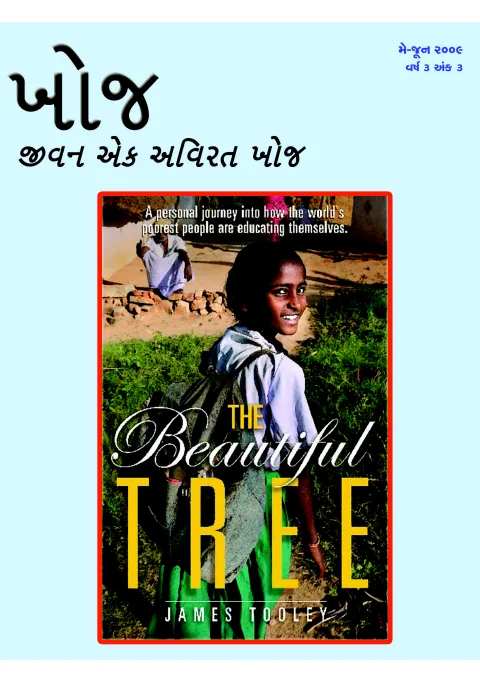
This is the May–June 2009 issue (Year 3, Number 3) of Khoj (“Search”), a Gujarati-language liberal periodical edited by Ambrish Mehta and published from Fatehganj, Vadodara, by the Arch (Action Research in Community Health and Development) group. The issue’s tagline is “Jivan ek avirat khoj” (“Life is a ceaseless search”), and its cover prominently features James Tooley’s book The Beautiful Tree, reprinted with acknowledgement to the Cato Institute. The editorial frames the central concern of the issue: the Indian government’s failure to deliver quality schooling to poor children, despite the 15th Lok Sabha election having just returned the Manmohan Singh-led UPA to power with a clear mandate. The editor argues that while middle-class families can exit to private schools, the poor are trapped in non-functioning government schools where teachers do not show up; Tooley’s reportage from Hyderabad, Nigeria, Ghana, Kenya, and China is offered as evidence that poor parents themselves are paying Rs. 50–200 a month for low-fee private schools, and that policymakers wrongly dismiss these as exploitation rather than nurturing them.
The issue is built around the post-election moment. Ashwinkumar N. Karia opens with a long essay on “election times” and the duty of Lok Sabha candidates to be accountable to citizens, listing ten concrete failures of the rule of law in India and ten reform proposals — from culling obsolete laws to making MPs answer to their constituents between elections. Ambrish Mehta’s lead political essay, “Election Results: Signals and Challenges,” reads the 2009 verdict as a decisive rejection of caste- and communal-bloc politics in favour of a more developmental, governance-focused mandate, drawing on Shekhar Gupta and Thomas Friedman to argue that aspiration has displaced grievance. Ramachandra Guha contributes “India… meri jaan… Fifty… Fifty…,” a translated reflection on whether India is genuinely democratic, answering “fifty-fifty” — democratic in elections and individual rights, much less so in the conduct of parties and institutions.
Other pieces include Shekhar Gupta on Manmohan Singh’s signature work, the Gujarati abridgement of the first two chapters of Tooley’s The Beautiful Tree, Ashwin Karia on the Right to Education Bill, Javed Anand on Islam (beards, burqas, or the thirst for knowledge?), Trupti Parekh on Dr. Binayak Sen’s bail, Dinesh Shukla on what Marx might have advised the G-20, Jayanti Patel reviewing Gandhi, Alvida?, and a short story by Kardam R. Modi. The issue sits squarely in the classical-liberal current of post-2008 Gujarati public intellectual life — pro-market, sceptical of state monopoly in education, defensive of civil liberties, and explicitly indebted to Cato Institute material.
Key points
- The cover story is a Gujarati appreciation and partial translation of James Tooley’s The Beautiful Tree, with explicit acknowledgement to the Cato Institute, which published the book.
- The editor Ambrish Mehta argues that low-fee private schools in slums of Hyderabad and in Nigeria, Ghana, Kenya, and China — charging Rs. 50–200 a month — are the real story of how the world’s poorest educate their children, not government schools.
- Ambrish Mehta’s lead political essay reads the 2009 Lok Sabha verdict for the UPA as a rejection of the post-1988 Mandal-and-Mandir caste-and-communal politics, citing Shekhar Gupta and Thomas Friedman on the shift from grievance to aspiration.
- Ashwinkumar N. Karia’s opening essay enumerates ten concrete failures of the rule of law in India — obsolete statutes still on the books, capricious enforcement, no review mechanisms, public ignorance of beneficial laws — and ten corresponding reform proposals.
- Ramachandra Guha’s translated essay “India… meri jaan… Fifty… Fifty…” answers the question of whether India is truly democratic with “fifty-fifty”: yes on elections and individual rights, no on the conduct of parties and institutions, quoting Sunil Khilnani that India is rewriting the inherited Western theory of democracy.
- Letters in the issue debate the previous “Aarthik Katokati” (economic crisis) special, with readers arguing that free-market discussion in Gujarati is still in its infancy and that economic understanding requires more grounding.
- Trupti Parekh contributes a piece on Dr. Binayak Sen’s bail, signalling the journal’s civil-liberties commitments alongside its market-liberal economics.
- The masthead lists an editorial board including Trupti Parekh, Anil Patel, Rajesh Mishra, and an advisory committee with Sudarshan Iyengar, Kirit Panwala, Niimisha Shukla, Parth Shah, and C.A. Tripathi — placing the journal in the Arch-Vadodara network of Gujarati liberal opinion.
Metadata and summary are AI-extracted from the source PDF and reviewed for editorial accuracy. The original work is available via the Read PDF tab above (where present); paragraph-level citation inside the PDF is deferred to a future engagement.