
periodical issue
Khoj : May - June, 2008
Pahel — Initiative for Open Society, Vadodara · 2008
52 pages
Summary
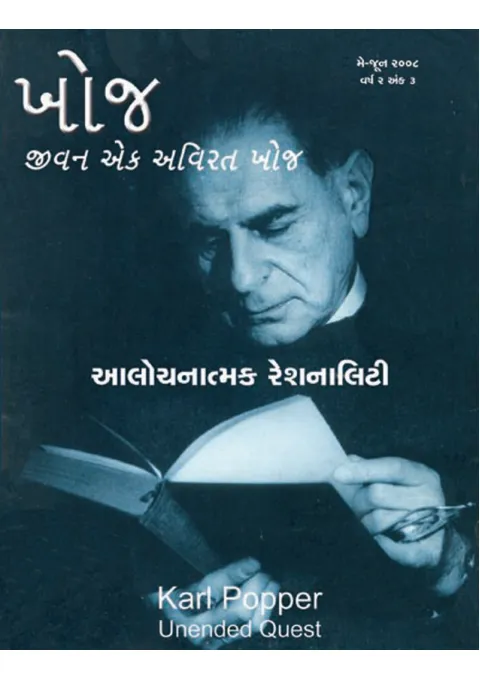
This is the May–June 2008 issue of Khoj (Year 2, Issue 3), a Gujarati-language periodical edited by Ambrish Mehta and published from Vadodara by the organisation Arch (Action Research in Community Health and Development). The masthead motto, ‘Jivan ek avirat khoj’ (Life is a ceaseless quest), and the cover image of Karl Popper alongside the lead theme ‘Aalochanatmak Reshanaliti’ (Critical Rationality) signal the magazine’s intellectual orientation: a forum for rationalist, civil-liberties-minded debate in Gujarat in the aftermath of the 2002 violence and during Narendra Modi’s chief ministership.
The issue opens with an editorial on the release on bail of twelve Adivasi accused from the Antarsuba ashram case in Vijaynagar, where police firing on 13 February had killed two tribals and injured several more; the editor argues that the police, not the Adivasis, deserve prosecution, and praises Gujarat High Court Justice D. N. Patel’s intervention. A long letters-and-responses section continues an earlier debate between contributors Ramanbhai Pathak, Rasik Shah, Harshadbhai Vyas, B. A. Pandya, Ramesh Pandya and others over rationalism, the Gujarati translation of ‘rational’, spirituality, dairy-versus-decentralised production, and the political character of Modi’s Gujarat. Jayanti Patel’s piece ‘Reshnalitini Aadhunik Vibhavna’ (The Modern Conception of Rationality) and Kiran Desai’s ‘Sarvajanahitaay Aatmkhoj’ both engage critically with editor Ambrish Mehta’s stance on rationalism, Hindutva and ‘dominant discourse’.
The ‘Sampratha’ (current affairs) section carries Trupti Parekh’s lead essay ‘Aapni Mulbhut Swatantrato Surakshit Chhe Khari?’ (Are Our Fundamental Freedoms Really Safe?), which dissects the sedition charges (IPC 124A) filed in June 2008 by Ahmedabad Police Commissioner O. P. Mathur against the local Times of India editor, a reporter and a photographer, comparing the move to British-era prosecutions of Tilak. A companion piece reports the 22 June 2008 Abhivyakti-Swatantrya Sammelan in Ahmedabad, a state-level free-speech convention convened by JP centenary committee, PUCL and others, which passed a resolution against the use of sedition law on journalists (including cases against Aaj Tak, Saamna, Aajkaal-Rajkot, Yang Aarodhi-Veraval, Nafisa Ali and Divya Bhaskar) and the Andhra Pradesh police action against Andhra Jyothi under the AP Atrocities Act. Further articles in the issue cover the Amarnath yatra controversy, judicial overreach (Rajeev Dhavan, Ashwin Karia), forest rights act implementation, and a serialised ‘Vigyan-Adhyatm’ (Science-Spirituality) essay by Anil Patel.
Key points
- Khoj is a bi-monthly Gujarati periodical edited by Ambrish Mehta and published by Arch from Fatehgunj, Vadodara, with an annual subscription of Rs. 150.
- The cover features Karl Popper and the theme of ‘critical rationality’ (aalochanatmak reshanaliti), referencing Popper’s autobiography ‘Unended Quest’.
- The editorial defends 12 Adivasis released on bail after the 13 February 2008 Antarsuba ashram police firing in Vijaynagar, in which two tribals were killed, and praises Gujarat High Court Justice D. N. Patel for granting relief.
- Trupti Parekh’s lead essay analyses the June 2008 sedition (IPC 124A) case filed by Ahmedabad Police Commissioner O. P. Mathur against the Times of India local editor, reporter and photographer for stories on the city police’s record.
- A 22 June 2008 free-speech convention in Ahmedabad, convened by the JP Centenary Committee, PUCL, Bhumiputra, Nava Marg and others, passed a resolution against the misuse of sedition law on journalists and recalled the 1975 Emergency.
- Letters and responses extend an ongoing debate among Ramanbhai Pathak, Rasik Shah, Harshad Vyas, B. A. Pandya and Ramesh Pandya about the meaning of ‘rationality’, Gandhian decentralisation, dairy versus capital-intensive production, and globalisation.
- Jayanti Patel and Kiran Desai contribute critical responses challenging editor Ambrish Mehta’s framing of rationality, Hindutva and ‘dominant discourse’ in post-2002 Gujarat.
- Other items cover the Amarnath yatra dispute, an article on judicial excesses by Rajiv Dhavan, Ashwin Karia on the propriety of chief justices’ statements, and Trupti Parekh on the implementation of the Forest Rights Act.
Metadata and summary are AI-extracted from the source PDF and reviewed for editorial accuracy. The original work is available via the Read PDF tab above (where present); paragraph-level citation inside the PDF is deferred to a future engagement.