
periodical issue
Khoj : May - June, 2006
Pahel — Initiative for Open Society, Vadodara · 2006
52 pages
Summary
This is the May-June 2006 issue (Year 2, Issue 2; consecutive issue 8) of Khoj, a Gujarati-language bimonthly periodical edited by Ambrish Mehta and published from Fatehgunj, Vadodara, by the Arch-Initiative for Open Society (ARCH). The tagline ‘Jivan ek avirat khoj-aavishkar’ (life is an unceasing search and discovery) frames the magazine as a forum for classical-liberal inquiry, and the masthead lists an editorial board including Trupti Parekh, Anil Patel, and Rajesh Mishra, with an advisory committee that includes Rashmi Kapadia, Daksha Patel, Mahendra Choliya, Sudarshan Iyengar, Kirit Panwala, Apurva Kadeer, Nimisha Shukla, and Parth Shah.
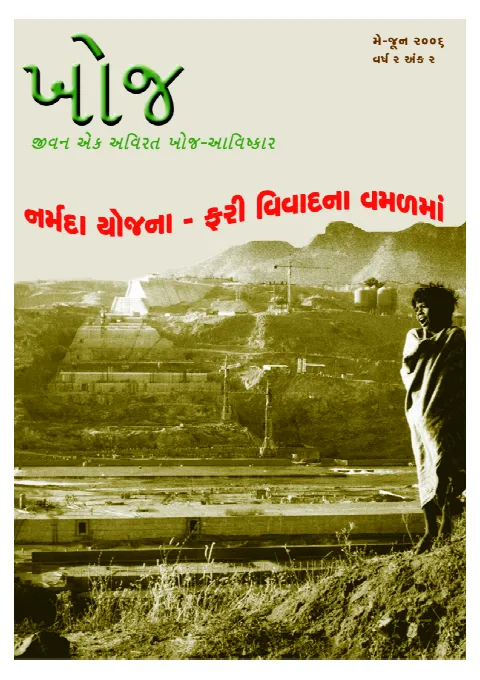
The cover story ‘Narmada Yojana - phari vivadna vamadma’ (The Narmada project - again in the whirlpool of controversy) by Ambrish Mehta defends rehabilitation policy for the dam’s oustees while reproducing and translating a critical Madhya Pradesh blog-post by California-based Siddharth Som, and a companion piece by Himanshi Shelat (‘Maunne sammati lakshan ganai levai te pehela…’) invokes Edmund Burke’s dictum that the only thing necessary for the triumph of evil is for good men to do nothing. The editorial frames the issue around ‘zero-economy’ development, the obligation to compensate displaced people, and the danger of communal majoritarianism overriding the rule of law in Vadodara after the demolition-drive violence on Gujarat’s ‘Gaurav Din.’
Other main articles include Dr. Suresh Amin’s response ‘Godhra, justice and other questions - the law needs to change,’ which critiques the Best Bakery and Zahira Sheikh trials, judicial pre-judgment, and the misuse of preventive detention; a P. C. L. report on Vadodara violence; Jaimini Mehta on urban planning; Swaminathan Aiyar’s ‘Shu mara koi merit chhe?’ on merit and reservations; Dinesh Shukla on international cooperation in the oil sector; and Kirit Panwala’s continuing series ‘Mare nyaay-vyavastha badalavi chhe - 2.’ The intellectual centrepiece is Part 6 of Anil Patel’s serial essay ‘Svatantrata - Gnan ane Bazaar’ (Freedom, Knowledge and the Market), which traces the Methodenstreit from Menger through Walras and Marshall to the socialist-calculation debate between Mises, Hayek, Lange, and Lerner, citing Peter Bauer and F. A. Hayek as epigraphs and treating Austrian economics as the decisive answer to positivist and socialist economic thought.
Key points
- Issue is Year 2, No. 2 (consecutive No. 8) of Khoj, May-June 2006, edited by Ambrish Mehta and published by ARCH / Initiative for Open Society from Fatehgunj, Vadodara.
- The cover essay by Ambrish Mehta defends the Sardar Sarovar Narmada project and its rehabilitation policy while engaging a critical piece by Siddharth Som on Madhya Pradesh displacement.
- Himanshi Shelat’s accompanying article quotes Edmund Burke - ‘The only thing necessary for the evil to triumph is for the good men to do nothing’ - to attack majoritarian silence.
- Dr. Suresh Amin’s response on Godhra argues that the judiciary pre-judged the Best Bakery / Zahira Sheikh case, and that perjury, preventive detention, and disproportionate-assets law all need structural reform.
- Anil Patel’s serial ‘Svatantrata - Gnan ane Bazaar’ Part 6 narrates the Austrian-school case against Keynesian macro and socialist central planning via Menger, Walras, Mises, Hayek, Lange and Lerner.
- Swaminathan Aiyar contributes a piece on merit (‘Shu mara koi merit chhe?’) and Dinesh Shukla writes on the need for international cooperation in the oil sector.
- Letters columns engage earlier coverage of the NPV (Net Present Value) regime for forest-land diversion, mangrove destruction at Mundra, and Saurashtra’s water-harvesting movement.
- Annual subscription is listed at Rs. 120, with cheques payable to ARCH (Action Research in Community Health and Development), Vadodara; printed by Vishal Offset.
Metadata and summary are AI-extracted from the source PDF and reviewed for editorial accuracy. The original work is available via the Read PDF tab above (where present); paragraph-level citation inside the PDF is deferred to a future engagement.