
periodical issue
Khoj : May-June, 2005
Pahel — Initiative for Open Society, Vadodara · 2005
56 pages
Summary
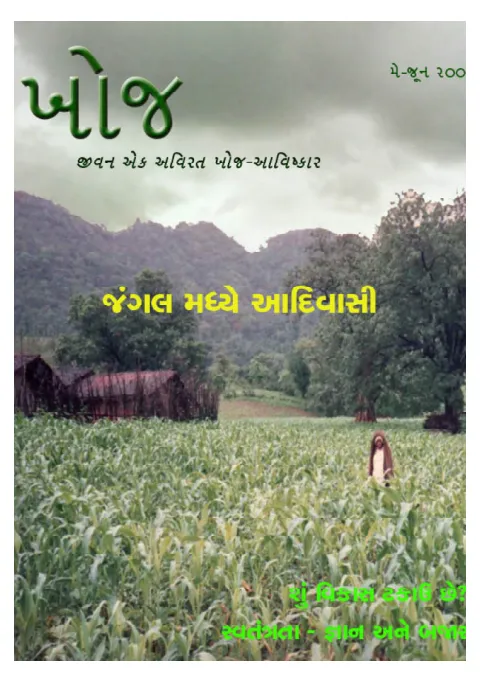
This is the May–June 2005 issue (Year 1, Issue 2) of Khoj (‘Search’), a Gujarati-language bi-monthly periodical published from Vadodara by Ambarish Mehta on behalf of ARCH (Action Research in Community Health) and its ‘Pahel’ Initiative for Open Society. Its tagline, ‘Jeevan ek avirat khoj-aavishkar’ (‘Life is a continual search and discovery’), signals the journal’s ambition to bring rigorous, rationalist debate on liberty, knowledge, the market, environment and tribal rights to a Gujarati readership. The editorial board includes Trupti Parekh, Anil Patel and Rajesh Mishra, with an advisory committee of Gujarati public intellectuals (Rasmi Kapadia, Daksha Patel, Mahendra Choliya, Dhruv Bhatt, Sudarshan Iyengar, Firoz Khanwala, Aparna Panwala, Nimisha Shukla, Parth Shah).
The issue’s lead concern is the relationship between forests and India’s adivasis. The cover story ‘Jangal madhye adivasi’ (‘The Adivasi in the Forest’) by Trupti Parekh investigates the long-running blame placed on tribal communities for forest destruction in the Narmada catchment and elsewhere, arguing instead that colonial and post-colonial forest-department management — including the timber-contractor system and current ‘working plans’ — caused the damage, and that adivasis must be given secure rights for any sustainable forest regime to work. A companion editorial discusses the tiger’s disappearance from Sariska and the Centre’s draft on tribal forest rights.
The issue also opens a major series, ‘Swatantrata – Gnyan ane Bazaar’ (‘Liberty – Knowledge and the Market’) by Anil Patel, growing out of a 2003 GIDR (Ahmedabad) seminar with Sudarshan Iyengar. Part 1 lays out four conceptions of liberty — individual, political, inner, and economic-power-as-liberty — drawing on Auden, C. Bay, John Dewey and Hayek, and defends the free market as the only rational and humane development alternative against both Nehruvian central planning and the Gandhi–Vinoba Sarvodaya ‘third way’. A translated chapter from Hayek’s Road to Serfdom (‘Individualism and Collectivism’) accompanies it. Other pieces include Sudarshan Iyengar and Nimisha Shukla on whether ‘sustainable development’ can be sustained, a sceptical-environmentalist column by Ambarish Mehta in the vein of Bjørn Lomborg, an Anil Patel note on the Advani–Jinnah controversy and India–Pakistan reconciliation, and an extensive readers’ letters section responding to the inaugural March–April 2005 issue (including Kanti Shah, Kumar Bhatt, Vimla Thakar and others).
Key points
- Khoj is a Vadodara-based Gujarati bi-monthly edited by Ambarish Mehta and published by ARCH/Pahel (Initiative for Open Society), positioning itself as a rationalist, liberal voice in Gujarati public discourse.
- Trupti Parekh’s cover essay ‘Jangal madhye adivasi’ rejects the standard narrative that adivasis destroyed India’s forests, blaming colonial-era and post-independence forest-department working plans and the contractor system instead.
- The editorial connects the disappearance of tigers from Sariska to broader failures of state forest management and supports the Centre’s then-pending draft on tribal forest rights.
- Anil Patel launches a multi-part series ‘Swatantrata – Gnyan ane Bazaar’ that distinguishes individual, political, inner and economic liberty, citing W.H. Auden, Christian Bay and John Dewey.
- The series argues the free market is the only rational humane development path and critiques both Nehruvian central planning and the Gandhi–Vinoba Sarvodaya ‘third way’, including Anthony Giddens’s Third Way variant.
- A translated chapter from Friedrich Hayek’s Road to Serfdom titled ‘Vyaktivad ane Samuhvad’ (‘Individualism and Collectivism’) appears as the issue’s theoretical anchor.
- Sudarshan Iyengar and Nimisha Shukla contribute a sceptical theoretical piece questioning whether material-prosperity-based ‘sustainable development’ is in fact sustainable.
- Ambarish Mehta’s column ‘Sanshayatmak Paryavaranvadi’ introduces Bjørn Lomborg-style sceptical environmentalism to Gujarati readers, querying whether environmental decline is as advanced as activists claim.
- The lengthy ‘Patro/Pratibhavo’ letters section shows the journal’s reception by Gujarati intellectuals (Kanti Shah, Kumar Bhatt, Vimla Thakar, Pravinchandra Thakkar, Vasudev Vora and others) debating Popper, Hayek, Gandhi and Nehru.
Metadata and summary are AI-extracted from the source PDF and reviewed for editorial accuracy. The original work is available via the Read PDF tab above (where present); paragraph-level citation inside the PDF is deferred to a future engagement.