
periodical issue
Khoj : July - August, 2006
Pahel — Initiative for Open Society, Vadodara · 2006
48 pages
Summary
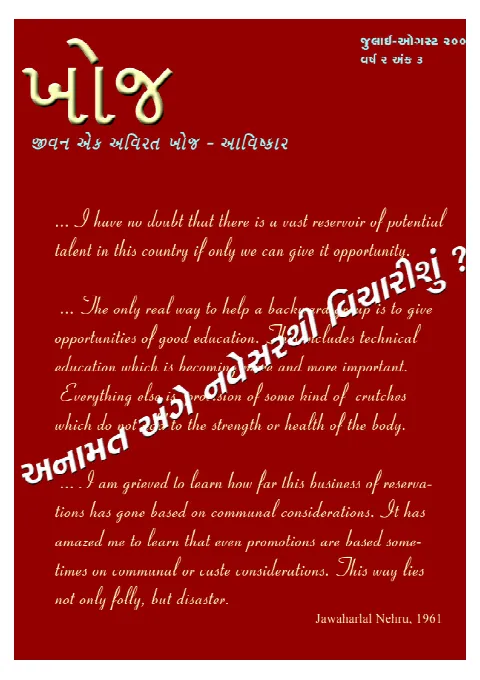
This is the July-August 2006 issue (Year 2, Issue 3) of Khoj, a Gujarati-language bimonthly periodical edited by Ambrish Mehta and published from Fategunj, Vadodara, by the ‘Pahel’ Initiative for Open Society. The masthead tagline ‘Jivan ek avirat khoj-aviskar’ (‘Life is an unceasing search and discovery’) signals the magazine’s classical-liberal, inquiry-driven temperament. This issue is anchored by an extended cover-feature on reservations (‘Anamat: navesarthi vichariyu shu?’ - ‘Should we rethink reservations from scratch?’), framed by a striking front-cover montage of Jawaharlal Nehru’s 1961 warnings against caste- and community-based quotas in promotions.
The editorial by Mehta revisits the magazine’s own 1980-81 stance during the Gujarat anti-reservation agitations, acknowledging that Dalits and Adivasis still need positive support, but arguing that further OBC-style reservations - particularly in central institutions and state-level quotas - now entrench caste, fragment society, and reward rent-seeking rather than effort. The argument is sharpened in companion pieces by Arun Shourie (on reservations and the constitutional scheme), a critical retrospective on the Mandal Commission by Mehta himself, and reflections by Rajesh Mishra. Anil Patel’s continuing serial ‘Swatantrata - jnana ane bajar’ (Liberty, Knowledge and the Market), Part 7, traces the arc from ‘hot socialism’ through ‘soft socialism’ to the welfare state, drawing on Hayek (quoted at length on economic freedom as the condition of all other freedoms), Mises, Lionel Robbins, Karl Popper, and the tragedy-of-the-commons critique of collectivist resource management.
Other features include Trupti Parekh on the July 2006 Mumbai train bombings (‘Ye hai Bambai, meri jaan’) and on the forced acquisition of Adivasi land at Kevadia for a private tourism project (‘Kisso Kevadiyano’); Shankar Gopalakrishnan on the Forest Rights Bill and tribal dispossession; Barun Mitra on China’s experiments with tiger conservation; Dr. Mahendra Chotalia on value-education; Kirit Panvala on judicial reform; and Sauvik Chakraverti on freeing the mind. The letters column carries detailed reader exchanges on the previous issue’s coverage of the Narmada project. Across all of it, Khoj reads as one of the few sustained Gujarati-language vehicles for an unapologetically classical-liberal critique of Indian statism, identity politics, and central planning.
Key points
- Cover feature reopens the reservations debate, using Nehru’s 1961 letters warning that caste- and community-based quotas in promotions lead to ‘folly and disaster’.
- Editor Ambrish Mehta argues that while reservations for Dalits and Adivasis remain justified, OBC quotas in central institutions and state-level expansions now entrench caste rather than dissolve it.
- A dedicated essay by Mehta dismantles the Mandal Commission’s methodology, paired with Arun Shourie’s piece on reservations and the constitutional scheme.
- Anil Patel’s serial ‘Liberty, Knowledge and the Market’ (Part 7) tracks the slide from ‘hot socialism’ (Stalin, Mao) through ‘soft socialism’ to the welfare state, citing Hayek’s 1961 statement that economic freedom is the indispensable condition of all other freedoms.
- Patel invokes Mises’s 1920s ‘socialist calculation’ critique, Lionel Robbins on scarcity, and Popper-Hayek on the dispersion of knowledge to argue that no central planner can substitute for market prices.
- Trupti Parekh’s report on the 11 July 2006 Mumbai train bombings praises the ‘rudest city’s’ civic spontaneity while criticising police failure and the temptation of reactive laws like POTA.
- Parekh’s ‘Kisso Kevadiyano’ documents the Narmada Nigam’s forced acquisition of Adivasi land at Kevadia village to lease at low rates to a private Mumbai hotel chain - a ‘public purpose’ fig-leaf the magazine treats as illegitimate even under liberalisation.
- Shankar Gopalakrishnan defends the 2005 Forest Rights Bill against critics who call it the ‘most dangerous act since 1947’, arguing that recognising Adivasi rights is a matter of justice, not patronage.
- Letters columns feature substantive technical exchanges on the Sardar Sarovar dam height (110m vs 121m vs 138m) and on unidentified-and-unidentifiable (UUO) project-affected populations.
- The issue is published by the Initiative for Open Society (‘Pahel’), Fategunj, Vadodara, with an annual subscription of Rs. 120 - signalling its small-circulation, donor-supported character within Gujarati liberal print culture.
Metadata and summary are AI-extracted from the source PDF and reviewed for editorial accuracy. The original work is available via the Read PDF tab above (where present); paragraph-level citation inside the PDF is deferred to a future engagement.