
periodical issue
Khoj : July - August, 2005
By Trupti Parekh, Anil Patel, Rajesh Mishra, Sauvik Chakraverti
Pahel — Initiative for Open Society, Vadodara · 2005
52 pages
Summary
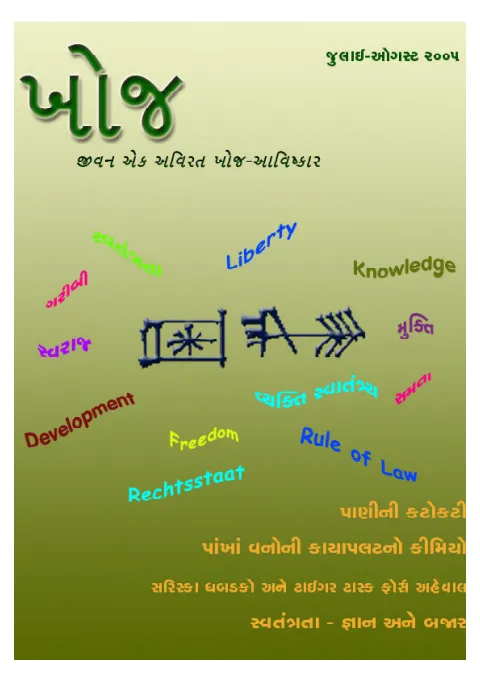
This is the July-August 2005 issue (Year 1, Issue 3) of Khoj, a Gujarati-language bimonthly journal edited by Ambrish Mehta and published from Fatehganj, Vadodara by ARCH (Action Research in Community Health) on behalf of Arya’s Initiative for Open Society. The tagline ‘Jeevan ek avirat khoj-aavishkar’ (life is a continuous quest and discovery) frames the magazine as a vehicle for translating liberal, classical-liberal and free-society ideas into Gujarati, and the cover collages the key vocabulary it wants to naturalise: swatantrata, vyakti-swatantrya, mukti, Liberty, Freedom, Knowledge, Rule of Law, Rechtsstaat, Development, samata, swaraj.
The editorial by Ambrish Mehta links the monsoon failure across Gujarat-Mumbai-Maharashtra to a sustained inquiry into water scarcity, arguing (with reference to Bjorn Lomborg-style ‘sceptical environmentalist’ data) that the crisis is one of management rather than absolute availability. A continuation of the previous issue’s ‘Jangal madhye Adivasi’ debate moves from centralised Forest Department control toward decentralised, community-based forest management, examined through the Sariska tiger debacle, the Tiger Task Force report, and Gujarat’s draft forest policy - all read against a ‘Guns and Guards’ versus community-stewardship frame. The ‘Swatantrata - Gyan ane Bajaar’ (Liberty - Knowledge and the Market) series, written by Anil Patel, takes its second instalment here, tracing how the idea of individual liberty and rule of law was hammered out in 17th-century England against arbitrary state power, with epigraphs from Hayek’s Constitution of Liberty and Gustav Radbruch on the Rechtsstaat.
Other articles include Trupti Parekh on the Nanavati Commission report, Imrana, the bar girls controversy and individual liberty; Ambrish Mehta on whether the water problem is one of quantity or management; and Anil Patel’s rejoinder to Sudarshan Iyengar and Nimisha Shukla’s earlier piece on ‘sustainable development,’ deploying Julian Simon against the ‘limits of resources’ thesis. A long letters section shows the journal positioning itself as an intellectual forum for Gujarat’s liberal-minded readers, with correspondents debating socialism vs. democratic socialism, solar energy, the Sardar Sarovar water-share dispute, and whether Khoj relies too heavily on foreign thinkers.
Key points
- Year 1, Issue 3 (July-August 2005) of Khoj, a Gujarati bimonthly edited by Ambrish Mehta and published by ARCH/Arya’s Initiative for Open Society in Vadodara.
- Cover layout pairs Gujarati liberal vocabulary (swatantrata, vyakti-swatantrya, mukti, swaraj, samata) with English/German equivalents (Liberty, Freedom, Knowledge, Rule of Law, Rechtsstaat), signalling the magazine’s translation project.
- Editorial frames the Gujarat water crisis as a management problem rather than scarcity per se, drawing on Bjorn Lomborg’s ‘sceptical environmentalist’ data.
- Lead policy thread continues the previous issue’s debate on tribals and forests, arguing for decentralised community forest management over Forest Department control, using the Sariska tiger crisis and the Tiger Task Force report.
- Anil Patel’s serialised essay ‘Swatantrata - Gyan ane Bajaar’ (Part 2) traces the 17th-century English origins of rule of law and individual liberty, opening with epigraphs from F.A. Hayek’s Constitution of Liberty (1960) and Gustav Radbruch (1950) on the Rechtsstaat.
- Trupti Parekh contributes a current-affairs digest covering the Nanavati Commission report on Godhra/2002, the Imrana case, the Mumbai bar girls controversy, and Gujarat’s draft forest policy.
- Anil Patel rebuts the previous issue’s ‘sustainable development’ piece by Sudarshan Iyengar and Nimisha Shukla, marshalling Julian Simon against the ‘limits to resources’ thesis.
- An unusually long letters section debates socialism versus democratic socialism (with reference to Jayaprakash Narayan and Lohia), Karl Popper, the Sardar Sarovar water-allocation dispute affecting Kutch, and whether Khoj over-relies on Western liberal thinkers.
Metadata and summary are AI-extracted from the source PDF and reviewed for editorial accuracy. The original work is available via the Read PDF tab above (where present); paragraph-level citation inside the PDF is deferred to a future engagement.