
periodical issue
Khoj : January - February, 2010
Pahel — Initiative for Open Society, Vadodara · 2010
40 pages
Summary
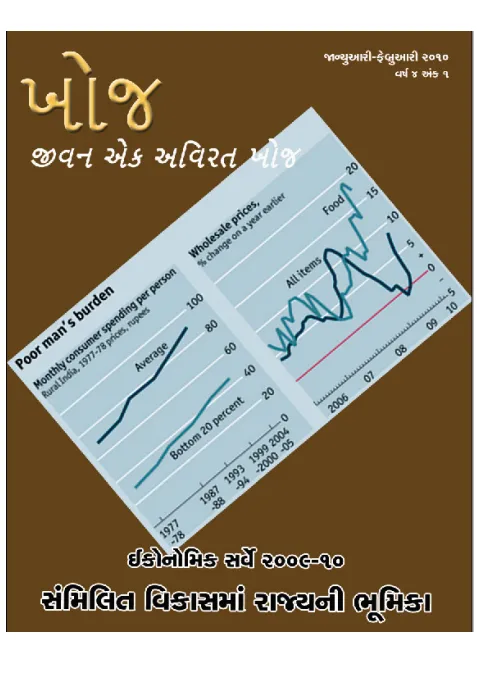
This is the January–February 2010 issue of Khoj (“Life is an unceasing search”), a Gujarati-language liberal bimonthly edited by Ambrish Mehta and published from Fatehgunj, Vadodara. The issue marks the start of Year 4, Issue 1, and headlines the cover with the theme ‘Economic Survey 2009–10: The Role of the State in Inclusive Growth’ (Sammilit Vikas-ma Rajya-ni Bhumika), illustrated with two Economist charts on rural Indian consumer spending and wholesale price inflation.
The lead editorial by Ambrish Mehta argues that the 2009–10 Economic Survey breaks from past template-driven reports by including a chapter, ‘Micro-foundations of Inclusive Growth,’ authored under the guidance of the UPA government’s chief economic adviser Prof. Kaushik Basu (a student of Amartya Sen, long at the Delhi School of Economics and lately Cornell). The editorial frames inclusive growth in liberal terms: government should play an ‘enabling’ rather than ‘controlling’ or ‘interventionist’ role, leaving the market to function while directing public effort at delivering education, healthcare, and nutrition to the poor. It criticises food, fuel and cooking-gas subsidies as corruption-prone and ineffective. The issue carries a Gujarati paraphrase of the Basu chapter (translated as ‘Sammilit Vikas-ma Rajya-ni Bhumika’, pp. 20–31).
The issue is in the classic Khoj idiom — letters and rejoinders (‘Patro / Pratibhavo’), reflections, and policy pieces. Jagdish Patel debates Ambrish Mehta on whether free markets alone can secure worker safety (citing Triangle Shirtwaist 1911, Bhopal 1984, and US OSHA experience). Suryakant Parikh urges Khoj to take up sanitation as its next campaign, citing Sulabh International and the editor’s own ‘Toilet-ni Duniya’ booklet. Prof. Ashwin Karia covers the Mahuva andolan in Bhavnagar against the Nirma cement plant on 4500 hectares of fertile Padhiarka land, led by BJP MLA Dr Kanubhai Kalsariya. The Gujarat-Mumbai Rationalist Association demands repeal of the compulsory-voting law passed by the Gujarat assembly in December 2009. Swaminathan Anklesaria Aiyar (translated from Sunday Times, 31/1/10 by Trupti Parekh) argues against teaching English from Class 1 in place of the mother tongue, citing Helen Abadzi’s cognitive-neuroscience work and the Zambia experience. Ketan Shukl writes on innovative education (‘Flute Mandir’, ‘Discovery Channel from waste’). Other items include Jashwant B. Mehta on rainwater harvesting and Dinesh Shukla on the Gujarati press.
Key points
- Cover theme is the Economic Survey 2009–10 and the role of the state in inclusive growth, with charts borrowed from The Economist on rural consumption and wholesale price inflation.
- Editor Ambrish Mehta praises Kaushik Basu’s chapter ‘Micro-foundations of Inclusive Growth’ as the first time a government document has discussed inclusive growth with such depth, and the issue carries a Gujarati paraphrase of it.
- The editorial frames the liberal position: government should be an ‘enabling’ force rather than a ‘controlling’ or ‘interventionist’ one — letting markets work while directly delivering education, health and nutrition to the poor, instead of running corruption-prone food/fuel/LPG subsidies.
- Jagdish Patel rebuts Ambrish Mehta in ‘Khoj-ni Khoj-ma’, arguing that free markets cannot by themselves secure worker safety and citing the Triangle Shirtwaist fire (25 March 1911), Bhopal Union Carbide 1984, and the role of US OSHA.
- Suryakant Parikh (‘Khoj have Sanitation-ni’) urges Khoj to take up sanitation as its next focus, noting that 80% of Indians and 30% of urban India still lack toilets, and citing Sulabh International (founded 1975, active in 13 states).
- Prof. Ashwin Karia reports on the Mahuva andolan in Bhavnagar district against the Nirma cement factory’s acquisition of 4500 hectares of fertile Padhiarka land, led by BJP MLA Dr Kanubhai Kalsariya; a 25 February 2010 Sabarmati Ashram rally was blocked by police.
- The Gujarat-Mumbai Rationalist Association calls the Gujarat government’s December 2009 ‘compulsory voting’ law for local bodies undemocratic and demands its withdrawal, noting 15 of 30 countries that adopted it have since repealed it.
- Swaminathan Anklesaria Aiyar (translated from Sunday Times, 31/1/10) argues against introducing English from Class 1, citing Helen Abadzi’s ‘Efficient Learning for the Poor’ and the Zambia experience that mother-tongue-first instruction yields better English outcomes later.
- Ketan Shukl’s ‘Kelavani-na Navtar Prayogo – 2’ describes a village school in Ambari (Jasdan, Rajkot) running a ‘Flute Mandir’ and a ‘Discovery Channel from waste’ — students earned ₹2850 selling scrap and bought magazines, instruments and a dish subscription.
Metadata and summary are AI-extracted from the source PDF and reviewed for editorial accuracy. The original work is available via the Read PDF tab above (where present); paragraph-level citation inside the PDF is deferred to a future engagement.