
periodical issue
Khoj : January - February, 2008
Pahel — Initiative for Open Society, Vadodara · 2008
44 pages
Summary
This is the January-February 2008 issue (Year 2, Issue 1) of Khoj (“Jivan Ek Avirat Khoj” / “Life is a Ceaseless Quest”), a Gujarati-language bimonthly magazine edited by Ambrish Mehta and published from Fatehganj, Vadodara, in association with ARCH (Action Research in Community Health and Development). The masthead lists an editorial board including Trupti Parekh, Anil Patel and Rajesh Mishra, and a consulting committee with names such as Dakshaben Patel, Mahendra Chotaliya, Kirit Panavala and others, situating the journal in Gujarat’s tribal-rights and civil-liberties activist circles.
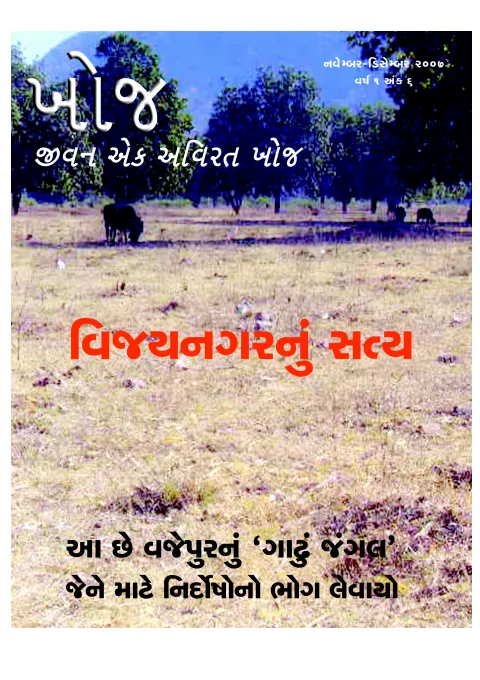
The issue is framed around its cover story “Vijaynagarnu Satya” (“The Truth of Vijaynagar”), an extended editorial-reportage piece by Trupti Parekh and Ambrish Mehta on a police firing in February 2008 in the Vijaynagar taluka of Sabarkantha, in which two Adivasis were killed and three wounded at the Antarsuba ashram range-forest office. The editors reconstruct the incident to argue that the Forest Department falsely framed local tribals as “large-scale forest cutters” and “soft Naxalites” in order to discredit the new Forest Rights Act, 2006, on whose enforcement the magazine has been campaigning. A companion editorial by Ambrish Mehta reads the 2007 Gujarat assembly election results as a sobering exercise in “inner-search” for the state’s liberal opinion. Two reportage pieces under “Taliyethi” by Rajesh Mishra and Trupti Parekh take up rampant police-extortion on private chhakda-jeep transport in rural Sabarkantha and the twenty-year Adivasi struggle around Deriyapada that culminated in the Forest Rights Act.
Under “Sampratha”, Trupti Parekh contributes a sceptical essay on the Tata Nano (“Neno Ek Swapnakatha”) weighing the small-car dream against environmental and urban-traffic costs, alongside a news round-up covering the Bilkis Bano verdict, the barbaric treatment of Jharkhand-Bihar Adivasi tea workers in Assam’s Gauhati, and Raj Thackeray’s anti-North-Indian agitation in Mumbai. The “Sanvad” section carries Rajesh Mishra’s translation of an interview with Lord Meghnad Desai, and the “Lekh” section features Jayanti Patel on rationality as a modern concept, Dinesh Shukla on nuclear weaponisation as the mark of a diseased polity, and a piece on Justice Khanna as “the voice of justice against power”. Throughout, the issue couples civil-liberties reportage with classical-liberal scepticism of the Indian state.
Key points
- Khoj is a Gujarati bimonthly edited by Ambrish Mehta from Vadodara and linked to the ARCH (Action Research in Community Health and Development) network of tribal-rights activists.
- The lead cover story “Vijaynagarnu Satya” investigates the February 2008 police firing at Antarsuba ashram in Sabarkantha that killed two Adivasis, arguing the Forest Department fabricated a Naxalite-and-forest-cutting narrative to undermine the Forest Rights Act, 2006.
- A second editorial by Ambrish Mehta reads the 2007 Gujarat election results as occasion for an “inner search” by liberal opinion in the state.
- Rajesh Mishra’s reportage details routine police and RTO extortion of private chhakda-jeep operators on Sabarkantha’s village routes, framing it as a case study in everyday corruption and rent-seeking.
- Trupti Parekh’s twin pieces narrate the twenty-year Adivasi land struggle in Deriyapada (Narmada district) that fed into the Forest Rights Act and the practical difficulties of implementing the new law through gram sabhas.
- Her essay on the Tata Nano questions whether a cheap small car for the middle class is good news once urban congestion, pollution and environmentalist critiques (citing Sunita Narayan and a Washington Post piece) are factored in.
- The news round-up celebrates the Bilkis Bano rape-and-murder conviction in Mumbai (January 2008) as a rare instance of justice for 2002 Gujarat riot victims, and condemns mob violence against Adivasi tea workers in Assam.
- A long “letters” section debates an earlier piece on John Ruskin and Dismal Science, and Prof. Yogendra Mankad contributes a critique of post-Soviet Russia, arguing that liberal intellectuals fell shamefully silent about Gulag survivors after 1991.
- The issue’s intellectual frame is signalled on page two by paired epigraphs from the Rig Veda and the Greek pre-Socratic Xenophanes, both gesturing at fallibilist enquiry as the journal’s animating ethic.
Metadata and summary are AI-extracted from the source PDF and reviewed for editorial accuracy. The original work is available via the Read PDF tab above (where present); paragraph-level citation inside the PDF is deferred to a future engagement.